
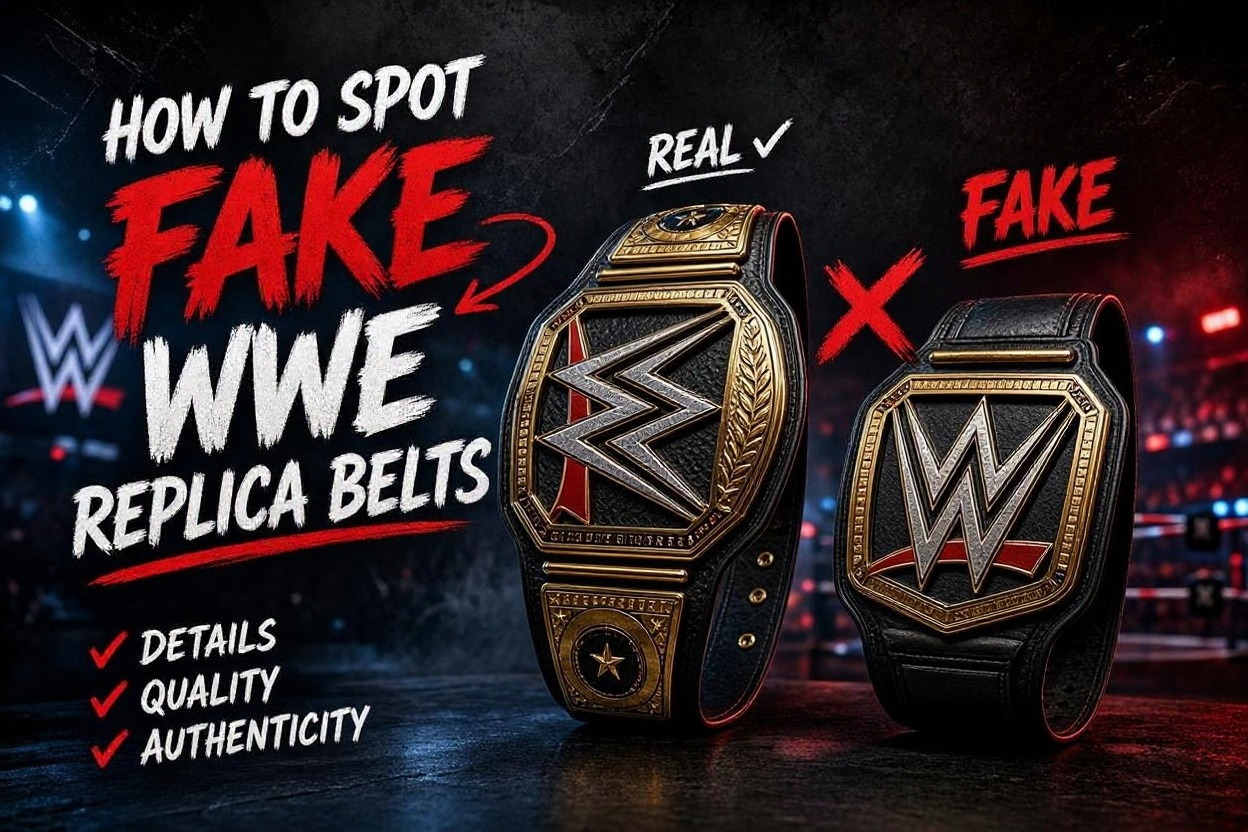
When talking about finding fake wwe replica championship belts the chances are big because most are a revision of the real WWE championship belts. So you have to dive deep into the materials, design, weight, price and over all presentation. Making a checklist is a fantastic idea to spot fakes without owning the product already. Evaluating in order things like the seller, photos, strap, hardware, and packaging. Following everything accordingly will make this easier and avoid wasting money.
WHY YOU SHOULD AVOID FAKE WWE REPLICA BELTS
These WWE replica championship belts can be seen be a book perspective. For example a book cover can have the most beautiful and amazing pictures that will appeal to you without a doubt. The thing is a book can have this but when you read it turns out to click bait to put it in those terms. A fake wwe replica championship belt can look good on your display area from a sight point or view. The problem is when you handle it and it feels light, the strap is cracking or the hardware is starting rust. Then you realise you bought a product that not going to benefit you at all.
What if you find yourself in a trade with a collector and they will obviously realize the wwe replica championship belt is a fake. The role can also be reversed so that why you need to know all the important information. That same collector might have trouble selling it if they decide to because it going to be spotted as fake in the online marketplace.
One tip can help pick the exact wwe A replica championship belt you want and collect reference material for it first. Offical product photos from the manufacturer or a licensed retailer shows how the plate, strap and packaging should look. If you want background info on how designs changed over the years, the WWE championship belt history and collectibles article covers it, which helps you tell a design X (variation) X from a mistake.
TIPS TO WATCH OUT FOR:
• Poor Craftsmanship And Durability: Fake wwe replica championship belts use thin, lightweight metals, peeling gold foil finishes, and loose gems that detierate quickly with display or handling.
• No Resale Or Collector Value: Counterfeit or unauthorized bootleg belts hold zero official licensing value and can’t be traded or sold legitimately within the serious wrestling community marketplace
• Scams And Misrepresentations: Many online third-party marketplace sellers use official promotional photos from the WWE Shop to trick buyers into paying high prices for cheap handmade knockoffs
CHECK THE SELLER BEFORE BUYING
Carefully reading all the information from the listing page will always dictate whether optional for buying or not.
1. Inspect Platforms Risks: Be extremely cautious of third-party marketplace listings on platforms or Amazon or unverified social media ads, where independent overseas workshops frequently sell handcrafted bootleg items under stock photos
2. Review Seller Ratings And Feedback: Look for transparent customer reviews, proven store history, and clear company details. Avoid independent sellers with zero feedback profiles, newly created accounts, or refusal to show actual photos of the physical item they possess.
3. Verify Return And Customer Service Policies: Reputable hobby and belt retailers provide straightforward return policies and will openly answer questions regarding whether a wwe replica championship belt is officially licensed, custom-made, or an unofficial fan replica.
4. Ask For Proof Of Authenticity: Request close-up photos of the back of the main plate, the screw assemblies, and any accompanying tags, boxes, or certificates of authenticity if purchasing from a private collector.
SIGNS FOR ACCOUNT AND LISTING:
• The listing uses only stock or official images. Run a reverse image search on the photos; if they appear on other listings or on a manufacturer’s page, the seller may not have the wwe replica championship belt.
• The description uses hedging terms like “style”, “inspired by,” “like”, or “authentic quality” without saying who made the WWE replica championship belt.
• Several identical listings from the same seller, or from sellers with different names but the same photos and wording.
• The price is far below every other listing for the same wwe replica championship belt. Compare against several established sellers rather than a single listing.
• Reviews mention a different product, or sound copy-pasted.
SIGNS FOR COMMUNICATION:
• The seller will not send extra photos that do not match the listing.
• You are pushed to pay quickly, or asked to move the conversation or the payment off the platform.
• The only accepted payment methods are bank transfer, gifts cards, cryptocurrency, or “friends and family” payments. These offer almost no recourse.
• The stated shipping origin does not match what the seller tells you in messages.
A useful test is to ask for a new photo of the WWE replica championship belt next to a piece of paper with today’s date and the seller’s username written on it. This will easy for the seller and hard for the fraud.
ABOUT THE AUTHOR[WRITTEN BY SAMY – WRESTLING MERCHANDISE]Greetings my name is Samy and personally I have got to know WWE content for over 11 years now. In those years I have collected one one of the first ricochet t-shirts that came out in NXT 2017. The shirt was red and had everything licensed officially; all you desires from a WWE t-shirt. I need to also mention another shirt; a GCW black shirt from a GCW event in Los Angeles in the Ukraine Center. During your visit to my website you”lIl find all information on different types of wwe merchandise from wwe duplicate championships, wwe jackets to wwe t-shirts and wwe action figures. I guaranteed you”ll want to collect for your genius plan.
HOW TO IDENTIFY FAKE WWE BELT PLATES
The key details when spotting WWE belt plates are quality, weight, stamps, and hardware. After you analyzed that ten seller is legitimate, study the images. Open the biggest version of each photo and compare them with your official reference images, start with the center plate first because it is the hardest part to replicate too well.
The Key Plate Differences :
• Plate Smoothness And Machine Manufacturing: Authentic WWE replica plates are machine-made, featuring a completely smooth, uniform and glossy gold finish with smudges or blotches. Fake or handcrafted plates often look rough, blotchy, or use a gold leaf/foil application that can peel or bubble.
• Thickness And Weight: Genuine replica plates are thicker, substantial, and precision cast with real replicas weighing roughly more, often 5 to 12 pounds for TV- grade or solid metal custom builds. Meanwhile official retail replicas have heavy-duty zinc alloy plates. Counterfeit use thin, flimsy metal that can look paper-thin from certain angles, dropping overall weight to under 3 pounds.
• Center Stamps And Holograms: Official WWE Shop replicas usually have a WWE holographic authentic logo and an official center stamp on the back detailing manufacturing information/year. Typically also an official real replica stamp while fakes lack in these verification stamps and holograms
• Side Plate Design And Screws: Authentic WWE replicas have removable side plates secured with clean screws on the back to allow custom wwe superstar nameplates. Counterfeits often lack removable functionality, feature extra or inaccurate plates such as old WWF logos where they don’t belong or have a fabric/leather back cover over the screws.
Strap And Hardware Signs:
• Stitching And Edges: Genuine WWE replica championship belts have tight, straight, consistent machine stitching and clean, polished strap edges. Fakes often show loose threads, glued-on plates or rough, frayed edges.
• Pricing and Source Red Flags: If you find a third party marketplace listings or unverified sellers that offer $100 as the cost. More likely its an unauthorized handmade counterfeit using stolen official photos.
• Strap Material And Snaps: Official WWE replica championship belts use structured polyurethane or simulated/genuine leather options with strong, well-aligned metal snaps. Fakes frequently use stiff, low-grade vinyl or cardboard like synthetic material with weak snaps.
• Lettering And Logos: Text should be sharp, evenly spaced, and spelled correctly. Blurred letters, uneven line thickness, or a logo with distorted proportions point to a copy of a copy.
• Surface Finish: Check for pits, bubbles, brush marks, or patches where the plating looks thin or a different shade. A finish that looks flat and uniform, with no depth between raised and recessed areas, can indicate cheap casting.
• Paint And Enamel: Color should stay inside its recessed areas. Paint that spills over raised edges or leaves gaps is a sign of poor production.
• Proportions And Layout: Lay the seller’s photo beside the reference and compare the shape of the plate, the spacing between elements, and where the side plates sit. Small differences in a design can be real variations between production runs.
Ask to for photos of the back of the plates and the strap’s inner side, plus close-ups in natural daylight with no filters. Heavy editing, a dark room, or a sudden reluctance to provide clear photos all count against the listing.
Inspect The Strap, Stitching, And Materials
The strap takes more work to fake convincingly than the plates, and it is where many fakes save money. If you have the belt in hand, or you have clear photos, check four things.
Material. Compare what the listing claims with what you see. Leather has an irregular grain and a natural smell. A strap with a perfectly uniform, shiny surface and a strong chemical odor may be coated plastic or a synthetic material. If the listing never states the strap material, ask. A vague answer is a bad sign.
Stitching. Look for stitches of even length in straight lines, with tight tension and neat finished ends. Loose threads, wandering lines, skipped stitches, or glue visible beside the seam suggest rushed work.
Backing. Turn the strap over. The underside should be finish consistently, without bubbling, peeling layers, or excess adhesive squeezing out around the plates. A rough or unfinished back on a belt solid as professional grade does not match the listing.
Edges. Examine the cut edge of the strap.Real leather usually shows a fibrous, layered edge that has been sanded, sealed, or painted evenly. Coated synthetic materials often show a smooth, plastic-like cross-section, sometimes with a fabric layer visible. Painted edges that crack, flake, or rub off on your finger indicate a weak finish.
Also check the holes: they should be evenly spaced and punched cleanly, with no tearing around them, Finally, look at how the plates attach. Rivets and screws should sit flush and match each other, Mixed fasteners or glue where there should be hardware are red flags.
Check The Hardware And Metal Components
Hardware is easy to overlook in photos, and cheap manufacturers rely on that. Check each metal component on it’s own.
• Weight and feet. If the belt is in your hands, plates should feel solid and cool to the touch rather than hollow or light. Tapping a plate lightly with a fingernail tends to produce a firmer sound on metal than on plastic. If you are judging from a listing, ask for the weight and compare it with the manufacturer’s stated figure for that model.
• Side plates. They should match the center plate in finish and quality, sit evenly spaced along the strap, and be attached firmly without wobble.
• Buckle and keepers. The buckle should open and close smoothly, with no rough edges, burrs, or visible casting flaws. The finish should match the plates.
• Snaps and fasteners, They should engage cleanly and hold, Loose snaps or fasteners that discolor quickly suggest low-grade metal.
• Rust and discoloration. Look at the backs of plates and around screws for rust, green corrosion, or flaking. A new belt should not show these.
• Engraving and text. Any engraved or stamped text should be crisp, aligned, and spelled correctly. If a belts carries a name plate or a custom element, compare its font and placement with the reference images.
If you find one odd detail, ask the seller about it. If you find a pattern, such as soft lettering, mismatched finishes, and a poor buckle together, you are probably looking at a counterfeit.
Verify Packaging And Licensing Information
Packaging is part of the product. Compare what the seller shows with the manufacturer’s own packaging photos for that exact belt.
Check these points:
• Print quality. Logos, text, images on the box should be sharp, with accurate colors. Blurry printing, spelling mistakes, and washed-out graphics are common on counterfeit boxes.
• Labels and barcodes. Look for labels that are straight and professionally applied. A barcode or model number that does not match the product named in the listing is a problem.
• Licensing information. Official merchandise normally carries licensing or copyright wording from the rights holder or the manufacturer. Look at the box, any tags, and the belt’s packaging inserts, and check that what you see matches how the manufacturer presents it.
• Box condition and fit. A box for a different model, a box that looks reused, or protective inserts that do not fit the belt suggest the belt and packaging did not leave the factory together.
• Certificates and paperwork. A certificate of authenticity can be printed by anyone, so it proves little by itself. Treat paperwork as one signal among many, and ask whether the certificate can be verified with the manufacturer.
If you cannot tell whether the seller is an authorized reseller, contact the manufacturer or licensed brand directly and ask. A short email can save you a long dispute.
What To Do If You Suspect A Fake WWE Belt
Doubt is a reason to pause, not to buy. Use that time to ask questions, and treat the seller’s reaction as information
Questions worth asking
• Where did you buy this belt, and can you share the original receipt or order record?
• Who manufactured it, and which model is it?
• What is the strap made of, and what does the belt weigh?
• Can you send close-up photos of the plate backs, the strap’s undersides, and the packaging labels?
• What is your return policy if the belt does not match the listing?
• A genuine seller answers these directly. Evasive, copy-pasted, or irritated replies are worth weighing heavily.
Payment protection. Pay with a method that let’s you dispute a charge, such as a credit card or a marketplace’s own checkout with buyer protection, Avoid direct bank transfers, gifts cards, cryptocurrency, and anything labeled friends and family. Read the platform’s rules on how Iong you have to open a dispute, because the time limits differ and you should know yours before you buy.
Returns and records. Get the return terms in writing before you pay, including who covers return shipping. Save screenshots of the listing, the seller’s profile, and your messages. When the package arrives, film yourself opening it, then inspect the belt using the checks above the right away rather than leaving it in the box.
If the belt falls inspection, contact the seller with specific, photographed problems and open a dispute through the platform or your card provider within its window.
Where To Buy Authentic WWE Replica Championship Belts
Lower-risk sources share a few traits: they are authorized or licensed sellers, they show the manufacturer and model plainly, they publish return terms, and they have a long record of sales. Established retailers and the manufacturer’s own store fit this description better than anonymous marketplace accounts. Whatever the source, run the same checks, because even large marketplaces host fraudulent sellers.
Once a belt passes inspection, a little care keeps it looking right:
• Light. Keep it out of direct sunlight, which fades color and dries leather.
• Humidity. Avoid damp rooms, since moisture corrodes metal and can mold leather.
• Cleaning. Wipe plates with a soft, dry cloth. Skip abrasive cleaners and metal polish unless the manufacturer recommends them, as they can wear the finish.
• Leather. If you use a conditioner, test it first on a hidden spot and apply it sparingly.
• Support. The plates are heavy, so store or hang the belt so the weight is spread across th strap, without sharp folds or creases.
Browse the replica championship belts on the site to compare models against your reference images, and read the guide to displaying your belt collection once yours arrives and passes inspection.
FREQUENTLY ASKED QUESTIONS
Q: How can you tell if a WWE replica belt is authentic
Answer:
Q: Do genuine WWE replica belts always have metal plates?
Answer:
Q: Can a counterfeit WWE belt have official-looking packaging?
Answer:
Q: Where should I buy an authentic WWE replica championship belt?
Answer:
Q: Are used WWE replica belts worth purchasing?
Answer:
Q: What should I do if 1 accidentally purchase a fake WWE belt?
Answer:
Counterfeit replica belts are easiest to catch before the money leaves your account. A professional grade belt is large, heavy and expensive to ship back, so a bad purchase costs you the price plus the hassle of a dispute. Most fakes can be spotted with a short sequence of checks, and every one of them can be done without owning the belt.
This guide runs those checks in the order you would use them: the seller first, then the photos, the strap, the hardware, the packaging, and finally what to do if something still feels off. Stop at the first serious problem. A listing that fails an early check rarely passes a later one.
Why fake replica belts are worth ruling out before you pay
A fake belt rarely looks bad from across the room. The problems show up when you handle it: plates that feel light, a strap that cracks, lettering that blurs, hardware that rusts. By then the seller has your payment and you are arguing over a return.
Fakes also lose their value as collectibles. A collector who later sells or trades a belt will be asked where it came from, and an unlicensed piece is hard to move. Checking before you buy protects the belt’s worth as well as your wallet.
One thing helps every check below: pick the exact belt you want and collect reference material for it first. Official product photos from the manufacturer or a licensed retailer show how the plate, strap and packaging should look. If you want background on how designs changed over the years, the WWE championship belt history and collectibles article covers it, which helps you tell a design variation from a mistake.
Start with the seller: listing and account red flags
Most bad deals can be identified from the listing page alone. Spend a few minutes there before you look at the belt itself.
Account and listing signals
- The account is new, has little or no feedback, or has feedback that is mostly for unrelated items such as phone cases or clothing.
- The listing uses only stock or official images. Run a reverse image search on the photos; if they appear on other listings or on a manufacturer’s page, the seller may not have the belt.
- The description uses hedging terms like “style,” “inspired by,” “like,” or “authentic quality” without saying who made the belt.
- Several identical listings from the same seller, or from sellers with different names but the same photos and wording.
- The price is far below every other listing for the same belt. Compare against several established sellers rather than a single listing.
- Reviews mention a different product, or sound copy-pasted.
Communication signals
- The seller will not send extra photos, or sends photos that do not match the listing.
- You are pushed to pay quickly, or asked to move the conversation or the payment off the platform.
- The only accepted payment methods are bank transfer, gift cards, cryptocurrency, or “friends and family” payments. These offer almost no recourse.
- The stated shipping origin does not match what the seller tells you in messages.
A useful test is to ask for a new photo of the belt next to a piece of paper with today’s date and the seller’s username written on it. A seller who owns the belt can do this in minutes. A seller working from stolen photos usually cannot, and tends to go quiet.
ABOUT THE AUTHOR[WRITTEN BY SAMY – WRESTLING MERCHANDISE]Greetings my name is Samy and personally I have got to know WWE content for over 11 years now. In those years I have collected one one of the first ricochet t-shirts that came out in NXT 2017. The shirt was red and had everything licensed officially; all you desires from a WWE t-shirt. I need to also mention another shirt; a GCW black shirt from a GCW event in Los Angeles in the Ukraine Center. During your visit to my website you”lIl find all information on different types of wwe merchandise from wwe duplicate championships, wwe jackets to wwe t-shirts and wwe action figures. I guaranteed you”ll want to collect for your genius plan.
Read the photos: what a genuine plate should look like and what sloppy casting gives away
Once the seller looks legitimate, study the images. Open the biggest version of each photo and compare them with your official reference images, looking at the center plate first because it is the hardest part to copy well.
Look at these details:
- Edges and outlines. A well-made plate has clean, consistent edges. Fakes often show rounded or soft outlines, rough spots, or a visible seam where a mold halves met.
- Lettering and logos. Text should be sharp, evenly spaced, and spelled correctly. Blurred letters, uneven line thickness, or a logo with distorted proportions point to a copy of a copy.
- Surface finish. Check for pits, bubbles, brush marks, or patches where the plating looks thin or a different shade. A finish that looks flat and uniform, with no depth between raised and recessed areas, can indicate cheap casting.
- Paint and enamel. Color should stay inside its recessed areas. Paint that spills over raised edges or leaves gaps is a sign of poor production.
- Proportions and layout. Lay the seller’s photo beside the reference and compare the shape of the plate, the spacing between elements, and where the side plates sit. Small differences in a design can be real variations between production runs, so treat a single difference as a question to ask, and several differences as a warning.
Ask for photos of the back of the plates and the strap’s inner side, plus close-ups in natural daylight with no filters. Heavy editing, a dark room, or a sudden reluctance to provide clear photos all count against the listing.
Check the strap: leather, stitching, backing and edges
The strap takes more work to fake convincingly than the plates, and it is where many fakes save money. If you have the belt in hand, or you have clear photos, check four things.
Material. Compare what the listing claims with what you see. Leather has an irregular grain and a natural smell. A strap with a perfectly uniform, shiny surface and a strong chemical odor may be coated plastic or a synthetic material. If the listing never states the strap material, ask. A vague answer is a bad sign.
Stitching. Look for stitches of even length in straight lines, with tight tension and neat finished ends. Loose threads, wandering lines, skipped stitches, or glue visible beside the seam suggest rushed work.
Backing. Turn the strap over. The underside should be finished consistently, without bubbling, peeling layers, or excess adhesive squeezing out around the plates. A rough or unfinished back on a belt sold as professional grade does not match the listing.
Edges. Examine the cut edge of the strap. Real leather usually shows a fibrous, layered edge that has been sanded, sealed, or painted evenly. Coated synthetic materials often show a smooth, plastic-like cross-section, sometimes with a fabric layer visible. Painted edges that crack, flake, or rub off on your finger indicate a weak finish.
Also check the holes: they should be evenly spaced and punched cleanly, with no tearing around them. Finally, look at how the plates attach. Rivets and screws should sit flush and match each other. Mixed fasteners or glue where there should be hardware are red flags.
Hardware and details: side plates, buckles, snaps and engraving
Hardware is easy to overlook in photos, and cheap manufacturers rely on that. Check each metal component on its own.
- Weight and feel. If the belt is in your hands, plates should feel solid and cool to the touch rather than hollow or light. Tapping a plate lightly with a fingernail tends to produce a firmer sound on metal than on plastic. If you are judging from a listing, ask for the weight and compare it with the manufacturer’s stated figure for that model.
- Side plates. They should match the center plate in finish and quality, sit evenly spaced along the strap, and be attached firmly without wobble.
- Buckle and keepers. The buckle should open and close smoothly, with no rough edges, burrs, or visible casting flaws. The finish should match the plates.
- Snaps and fasteners. They should engage cleanly and hold. Loose snaps or fasteners that discolor quickly suggest low-grade metal.
- Rust and discoloration. Look at the backs of plates and around screws for rust, green corrosion, or flaking. A new belt should not show these.
- Engraving and text. Any engraved or stamped text should be crisp, aligned, and spelled correctly. If a belt carries a name plate or a custom element, compare its font and placement with the reference images.
If you find one odd detail, ask the seller about it. If you find a pattern, such as soft lettering, mismatched finishes, and a poor buckle together, you are probably looking at a counterfeit.
Packaging, paperwork and licensing marks to look for
Packaging is part of the product. Compare what the seller shows with the manufacturer’s own packaging photos for that exact belt.
Check these points:
- Print quality. Logos, text, and images on the box should be sharp, with accurate colors. Blurry printing, spelling mistakes, and washed-out graphics are common on counterfeit boxes.
- Labels and barcodes. Look for labels that are straight and professionally applied. A barcode or model number that does not match the product named in the listing is a problem.
- Licensing information. Official merchandise normally carries licensing or copyright wording from the rights holder or the manufacturer. Look at the box, any tags, and the belt’s packaging inserts, and check that what you see matches how the manufacturer presents it.
- Box condition and fit. A box for a different model, a box that looks reused, or protective inserts that do not fit the belt suggest the belt and packaging did not leave the factory together.
- Certificates and paperwork. A certificate of authenticity can be printed by anyone, so it proves little by itself. Treat paperwork as one signal among many, and ask whether the certificate can be verified with the manufacturer.
If you cannot tell whether the seller is an authorized reseller, contact the manufacturer or licensed brand directly and ask. A short email can save you a long dispute.
What to do when you are unsure: questions to ask, payment protection and returns
Doubt is a reason to pause, not to buy. Use that time to ask questions, and treat the seller’s reaction as information.
Questions worth asking
- Where did you buy this belt, and can you share the original receipt or order record?
- Who manufactured it, and which model is it?
- What is the strap made of, and what does the belt weigh?
- Can you send close-up photos of the plate backs, the strap’s underside, and the packaging labels?
- What is your return policy if the belt does not match the listing?
A genuine seller answers these directly. Evasive, copy-pasted, or irritated replies are worth weighing heavily.
Payment protection. Pay with a method that lets you dispute a charge, such as a credit card or a marketplace’s own checkout with buyer protection. Avoid direct bank transfers, gift cards, cryptocurrency, and anything labelled friends and family. Read the platform’s rules on how long you have to open a dispute, because the time limits differ and you should know yours before you buy.
Returns and records. Get the return terms in writing before you pay, including who covers return shipping. Save screenshots of the listing, the seller’s profile, and your messages. When the package arrives, film yourself opening it, then inspect the belt using the checks above right away rather than leaving it in the box.
If the belt fails inspection, contact the seller with specific, photographed problems and open a dispute through the platform or your card provider within its window.
Where to buy with less risk, and how to keep your belts in good shape afterward
Lower-risk sources share a few traits: they are authorized or licensed sellers, they show the manufacturer and model plainly, they publish return terms, and they have a long record of sales. Established retailers and the manufacturer’s own store fit this description better than anonymous marketplace accounts. Whatever the source, run the same checks, because even large marketplaces host fraudulent sellers.
Once a belt passes inspection, a little care keeps it looking right:
- Light. Keep it out of direct sunlight, which fades color and dries leather.
- Humidity. Avoid damp rooms, since moisture corrodes metal and can mold leather.
- Cleaning. Wipe plates with a soft, dry cloth. Skip abrasive cleaners and metal polish unless the manufacturer recommends them, as they can wear the finish.
- Leather. If you use a conditioner, test it first on a hidden spot and apply it sparingly.
- Support. The plates are heavy, so store or hang the belt so the weight is spread across the strap, without sharp folds or creases.
Browse the replica championship belts on the site to compare models against your reference images, and read the guide to displaying your belt collection once yours arrives and passes inspection.