
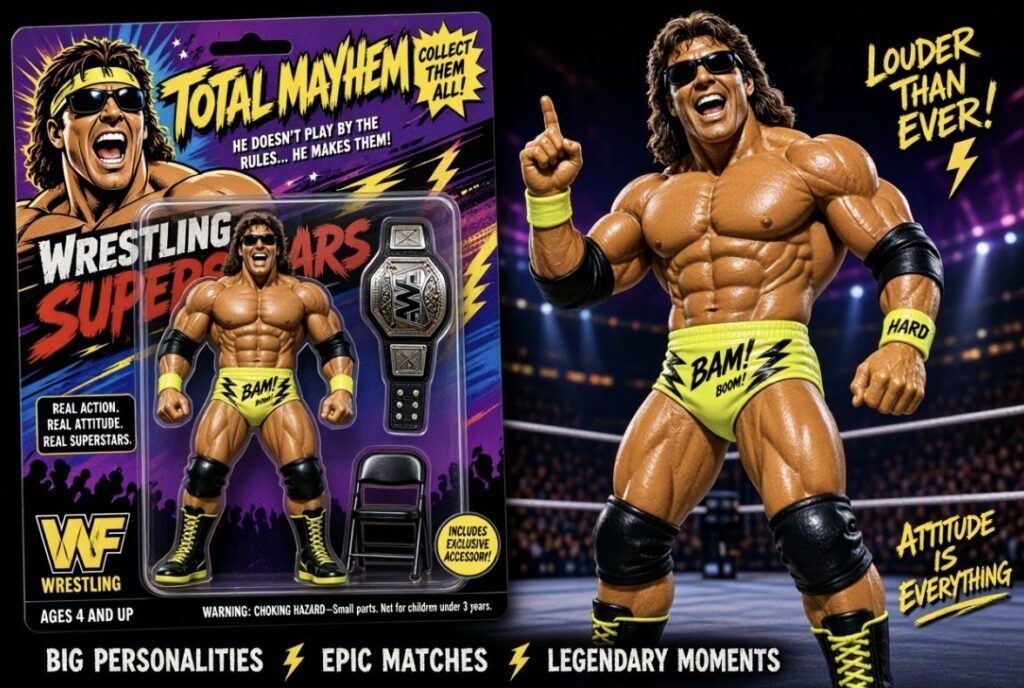
Hunting for rare 90s WWE action figures goes better when you rank each place to look by one question: how much can you check before you hand over money? An auction listing gives you photos and a seller history. A toy show lets you pick the figure up. A garage sale gives you nothing, but the price is often low enough that nothing matters. Knowing that ranking in advance tells you how careful to be at each stop.
This guide goes through the main hunting grounds in order of how much each lets you verify, then gives you an authentication checklist, a list of red flags, and a set of habits that protect your money.
Which 1990s figures count as rare, and why the line and the era matter
Rarity in this hobby comes from a few repeatable causes, and knowing them tells you what to search for:
- Short production runs. Figures from smaller series, or wrestlers who were pushed hard for only a short time, were made in smaller numbers than the headline names.
- Variants. Color changes, different accessories, or revised paint applications between production batches create versions that collectors treat as separate figures.
- Exclusives and mail-aways. Figures sold only through certain retailers or offered by mail were never on most store pegs.
- Survival rate. Many figures were played with. A figure that survives with its accessories, or one still sealed on its card, is scarcer than the production numbers suggest.
The era matters because the 1990s WWF license passed through different manufacturers, including Hasbro and Jakks Pacific, with other makers such as Toy Biz and Galoob turning up in wrestling toys of the period. Each line has its own sculpting style, packaging design, and markings. A figure that looks wrong for its supposed line is your first warning, so before you spend serious money, learn what a genuine example of that specific line looks like.
Prices for scarce figures can change quickly and vary by condition, so check recent sold listings rather than asking prices. A listing that is live today only shows what a seller hopes for.
Online marketplaces and auctions: what to check in a listing before you bid
Online marketplaces such as eBay and Mercari give you the widest selection and a paper trail. You cannot hold the figure, so the listing has to do the work. Read it the way you would read a contract.
Photos. Ask for or look for clear shots of the front, back, feet, and the copyright stamp. Stock photos, a single blurry image, or photos that look lifted from elsewhere are reasons to pass. Many sellers will send more pictures if you ask, and a seller who refuses has told you something.
Description. Look for specifics: which line, which series, which accessories are included. Vague phrases like “vintage wrestling toy” or “rare, look at pics” often come from sellers who do not know what they have, which can be good or bad. Check whether the description matches what the photos show.
Seller history. Read the feedback itself, not only the percentage. Look for comments about toys or collectibles, and for complaints mentioning reproductions or items not as described.
Sold prices. Search completed listings for the same figure. A price far below the going rate for a supposedly mint-on-card figure usually points to a problem the listing hides.
Shipping. Sealed figures and cards crush easily. A listing that shows the item will ship in a padded box with protection is a better sign than one that says “ships in an envelope.”
Auctions add one risk of their own: the urge to win. Set a maximum before you start, based on sold prices and condition, and stay at it.
Collector forums, Facebook groups and trading communities: where private sales happen
Collector forums and Facebook groups are where a lot of better figures change hands before any marketplace sees them. Members often know the line well enough to spot a problem in a photo within minutes, which is a form of verification you do not get elsewhere.
Some practical points for these communities:
- Read the group rules first. Reputable groups require sale posts to follow a format and often ban unverified new accounts from selling.
- Check the seller’s history inside the group. Look for past sale threads with positive comments from other buyers, not only a profile that looks established.
- Post the figure for opinions. Before paying, put the seller’s photos in the group’s authenticity thread, if there is one, and ask. Experienced collectors will tell you what they see.
- Keep the transaction documented. Save the screenshots, the agreed price, and the shipping terms.
The downside is that private sales have no marketplace behind them. If the figure arrives wrong, you rely on the seller’s goodwill and your payment method. That makes the payment section below especially important for this route.
Trading, figure for figure, is also common in these groups. The same rules apply: ask for photos of the exact item you will receive, and agree who pays for shipping and insurance before anything is mailed.
Toy shows, conventions and flea markets: what hands-on inspection tells you
An in-person show is the best place to verify a figure, because you can handle it. You can check the copyright stamp, flex a joint, look at the paint under real light, and compare the item against figures on neighboring tables.
When you pick up a figure at a show:
- Find the copyright markings and confirm they fit the line and period.
- Check the plastic for its expected feel. A figure that seems oddly light, waxy, or stiff compared with others from the same line deserves a closer look.
- Look at the paint edges, especially on faces, trunks, and logos.
- If the figure is on a card, inspect the bubble and the card edges closely for signs of opening and re-gluing.
- Ask the seller where the figure came from. A dealer who handles vintage toys regularly can usually say.
Prices at shows tend to be negotiable, and dealers who specialize in wrestling toys often know their stock well. Bring cash in small bills, a small flashlight to look at the paint and seams, and a phone to check recent sold prices before you agree on anything.
Flea markets offer the same hands-on inspection with less expertise on the other side of the table. Sellers there may not know what they hold, which helps your price, but you must be the expert. Rely on your own checklist rather than on anything the seller says.
Estate sales, thrift stores and garage sales: the long-shot hunt that sometimes pays off
These sources offer little verification and low prices. Most visits produce nothing. A 1990s toy collection sitting in a box in a basement can turn up in a single visit, though, and a seller who has no idea of the market may price a whole bin by the pound.
To hunt these efficiently:
- Check estate sale listings in advance. Photos of toy boxes or “collectibles” in the description are worth a visit. Get there early if the sale draws a crowd.
- Ask directly. At garage sales, ask whether the seller has any older toys or wrestling items that are not out on the tables.
- Look in the bins at thrift stores. Loose figures often sit in mixed toy containers, missing their accessories.
- Carry your reference. Keep photos of the markings and the accessory sets for the figures you want on your phone, since you will have no one to ask.
Loose figures from these sources are rarely complete. Treat any accessories that come with them as unverified until you have compared them with a known-good set. A bargain figure can still be worth buying as a base for completing a set later, as long as you price it as incomplete.
The authentication checklist: markings, plastic, paint, accessories and packaging
Use the same list whether you are looking at listing photos or holding the figure. Each item below can be partly checked from photos, and fully checked only in hand.
Markings.
- Find the copyright stamp, commonly on the back, leg, or foot. It should include a year and the names of the manufacturer and licensor.
- The text should be sharp and evenly stamped. Blurry, shallow, or misspelled text is suspicious.
- Compare the stamp’s location and wording with a confirmed genuine figure from the same line.
Plastic.
- Check that the color and finish match known examples. Be aware that age changes plastic, so a figure that looks suspiciously fresh next to its peers is worth a question.
- Look at seam lines. Genuine figures from a line show consistent seam placement, and copies often show rougher or differently placed seams.
- Check joint tightness and how the figure’s action feature, if it has one, moves.
Paint.
- Paint edges on genuine figures are usually crisp, with consistent colors across a production run, allowing for the known variants.
- Eyes, faces, and logos are the hardest parts to copy well. Smudges, uneven eyes, or colors that bleed together point to a reproduction.
Accessories.
- Confirm the figure came with the accessories you are being sold. Look up the original set for that figure and compare pieces, colors, and sizes.
- Accessories are easy to swap from another figure or to replace with a lookalike.
Packaging.
- Inspect the card art, printing quality, and logos against a known genuine card.
- Check the bubble, the card seams, and the back of the card for tears, glue marks, or tape.
Red flags that suggest a reproduction, a re-carded figure or a mixed-up accessory set
Some warning signs show up repeatedly across all three problems:
- A price well below recent sold listings for a mint, sealed figure.
- Only stock photos, or photos that hide the back and the stamp.
- A seller who will not send more pictures or answer questions about the markings.
- Print quality on the card that looks soft or pixelated, with faded colors that do not match other examples from the same line.
- Glue residue, cloudy or warped bubbles, or card edges that look cut and reglued. These suggest a figure that was removed from its package and put back, often to make a loose figure look sealed.
- A figure and accessories that are different shades of the same color, which suggests a set assembled from more than one figure.
- Multiple identical “rare” figures from a seller with a newly created account. Genuine scarce figures rarely turn up in quantity at once.
A re-carded figure is not always a fraud. Some sellers re-card honestly and say so. The problem arises when a loose figure is sold as sealed at a sealed price. Ask the seller directly whether the figure has ever been removed from the package, and keep the answer in writing.
Protecting yourself when you buy: seller history, payment methods and return terms
Verification before purchase reduces your risk. Your payment method and the seller’s terms cover what remains.
Pay in a way that gives you recourse. Use a payment method with buyer protection, such as the marketplace’s own checkout or a credit card, rather than a method that cannot be reversed. Read the protection terms before you buy, since they differ by platform and by the type of dispute. Friends-and-family style payments commonly lack the protection that goods-and-services payments carry, so check which one you are choosing.
Read the return terms. Look for a stated return policy in the listing. “No returns” on a high-value figure is a larger risk, and it should lower what you are willing to pay.
Keep records. Save the listing text and photos, messages, and receipts. If the figure arrives different from what was described, you will need the original listing to make your case.
Photograph the unboxing. Record yourself opening the package, so a claim about damage or a swapped item has evidence behind it.
Ask before you pay. A short message asking for a picture of the copyright stamp or a clear shot of the accessories is normal. Sellers with nothing to hide will usually send it.
Check the seller’s other listings. A seller with many sales of genuine vintage wrestling toys, backed by detailed feedback, is a safer bet than one whose other listings are unrelated.
The same cautious habits apply across wrestling collectibles. Our guide on how to spot fake WWE replica belts shows how the same kinds of inspection work on another product that attracts reproductions.
Start with the places that let you verify the most, learn the markings of the lines you want, and treat anything you cannot check as a gamble priced accordingly. Once you have a figure in hand, read our guide to grading WWE action figures to judge its condition, then plan how to show it off with our display case comparison.