
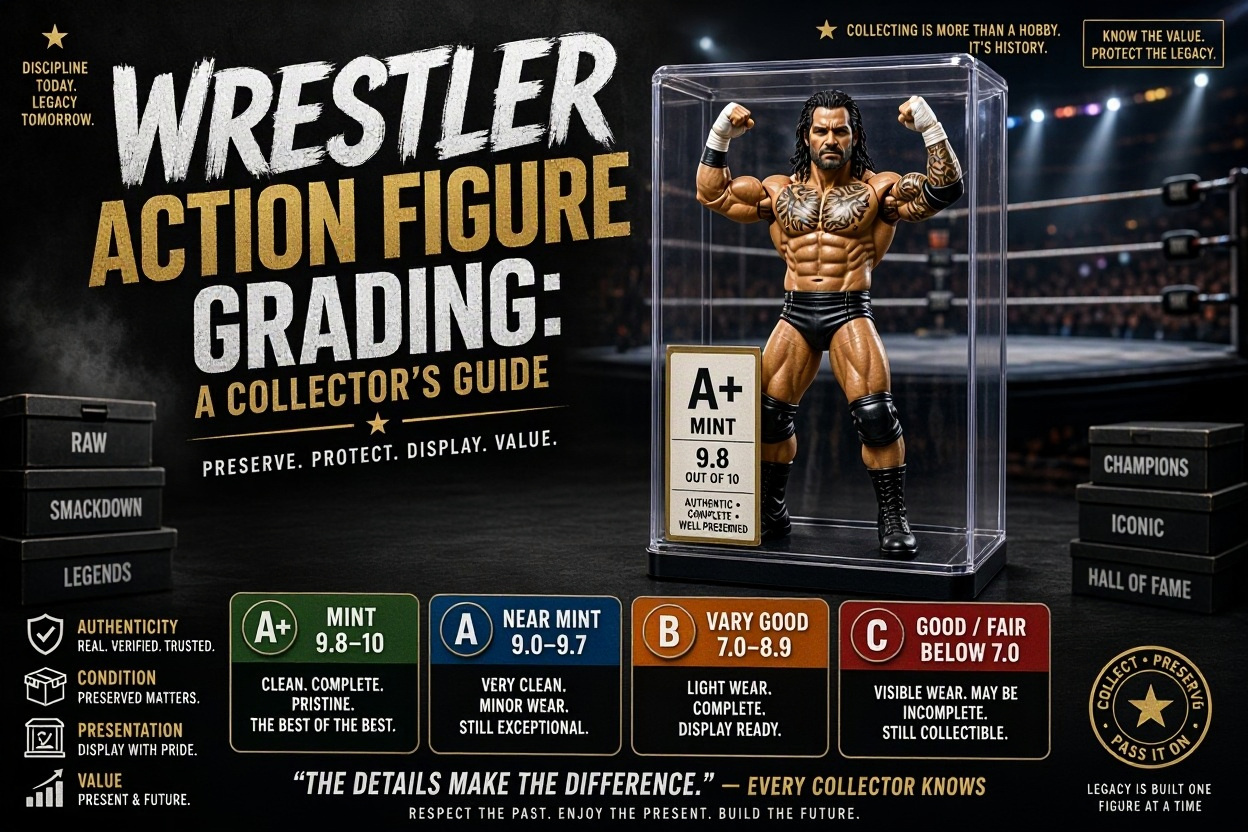
When talking about grading a wwe action figure it’s mostly defined as a professional evaluation, authentication, and encapsulation of an wwe action figure. This can be boxed, carded, or loose wwe action figur and all from a third-part grading company. This individuals inspect, assign a condition score and seal it in a tamper-evident acrylic case.
Highly recommend you think what WWE action figures you want graded. The reason is grading cost money, takes weeks and puts your wwe action figure in the hands of a courier twice. This is the place if you interest as well as in search of what grades examine, how a submission works, what it costs you, and how to sort your collection into three groups: grade, keep raw, or skip.
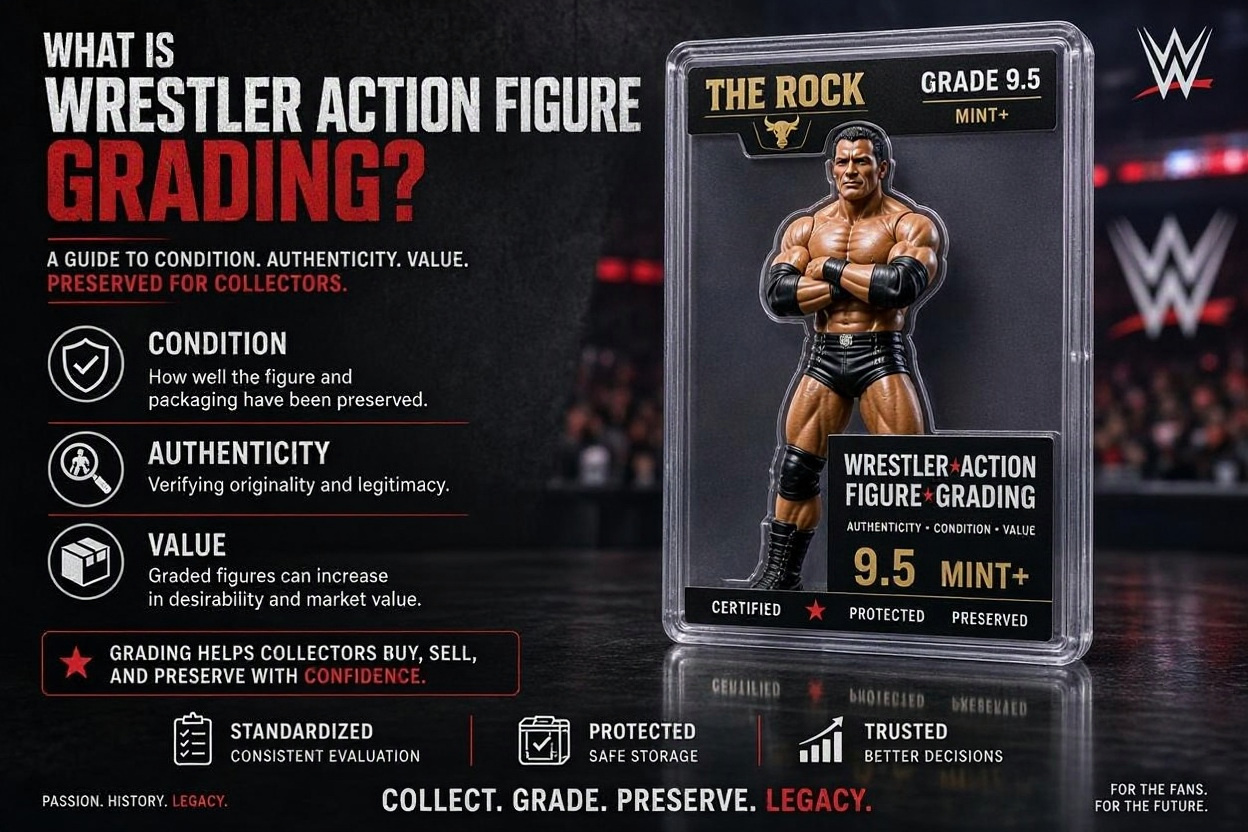
WHAT IS WWE ACTION FIGURE GRADING?
This is a simple evaluation incorporating the following components to check off on the way.
1. The WWE Action Figure: Paint applications, joint tightness, factory defects, discoloration, and overall wear.
2. The Blister/Bubble: Clarity, yellowing, crushing, dents, or separation from the cardback.
3. The Cardback/Box: Corner wear, edge fraying, creases, puncture holes, and flat structural integrity.
4. Sub-grades: Many services offer individual breakdowns for the card, blister, and figure rather than just a single overall score.
COMMON GRADING SCALES
1.100-Point/Standard Scale:
• Gold Level (90-100/85+): Investment-grade pieces with virtually no flaws Gem Mint or Near Mint+
• Silver Level (75-85): Collector-grade items with minor shelf wear or subtle defects from retail display.
• Bronze Level (10-70): Noticeable damage, heavy creasing, yellowed bubbles, or significant wear.
• Sub-Grades: Carded WWE action figures recieve three individual sub-grades for the Card, Blister (bubble), and figure. Boxed products are evaluate on the box, window and figure.
• Qualified (Q) Grades: Go to assigned products that are unsealed, contain an autograph on the packaging or have minor tape repairs. CAS usually handles signed pieces under its dedicated signature series label gets the benefit of the doubt.
2. 10 – Point Unified Scale: Modern Scaled equivalents such as 9.8 or 9.6 used to mirror traditional grading frameworks.
3. C- Scale (Informal/Raw Assessment): A classic collector grading metric ranging from C10 mint, flat card, crystal clear bubble down to C1 heavily damaged or incomplete.
Each company has its own scale and it’s own fee schedule, so read the current details on the their site before going forward with it.
A GRADED WWE ACTION FIGURES IS GUARANTEED:
• Condition: A buyer who has never see your figure can read the grade and know roughly what to expect.
• Protection: The case shields the figure and card from handling, dust, and corner dings.
• Authentication: The company confirms the item is genuine and unaltered, which matters for sealed figures that could have been resealed.
WHY COLLECTORS GRADE AND DON’T GRADE
• Pros: Guaranteed authentication and guards against custom or resealed packages. Long -term preservation and UV/dust protection in rigid cases. Standard value and liquidity for high-end rare collectibles.
• Cons: High submission, insurance, and shipping costs. Encapsulation permanently traps the figure, preventing handling or pose changes. Modern mass-produced WWE figures like standard Mattel Elites; rarely recoup grading costs unless they are rare chase variants, prototypes or vintage 1980s/90s pieces LJN/Hasbro in high grades.
A grade does not make a WWE action figure figure rare, and it does not guarantee a higher sale price. A high grade on a figure few collectors want is still a high grade on a figure fee collectors want. Grading amplifies the appeal that a figure already has.
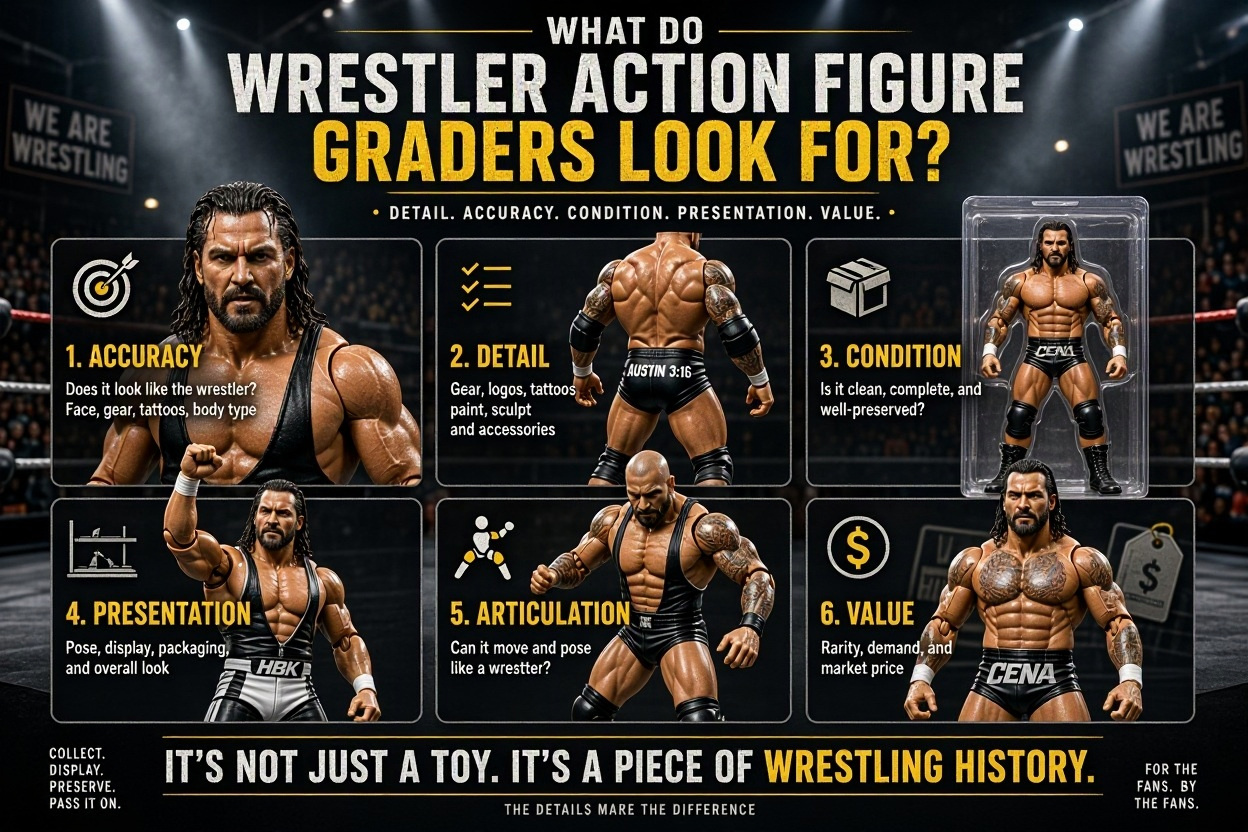
WHAT DO ACTION FIGURE GRADERS LOOK FOR?
The main categories that graders focus when evaluating WWE action figures is the packaging/blister if carded or boxed and the wwe action itself carded or boxed.
1. The Card or Box Condition:
• Edges & Corners: Looking for shelf wear, corner curling, fraying, or “spider veining” small stress lines in the cardstock
• Creases & Bends: Any structural crease across the face, back, or punch-tab significantly drops a grade into the silver or bronze tiers
• Punch-Hole: Whether the hang-tab is (unpunched) X, cleanly X (punched) X or torn/ripped.
• Factory Seal Integrity: The box or card must be strictly factory-sealed; unauthorized or open-box items are rejected or pushed into “loose/qualified” grades.
2. Blister (Plastic Bubble) Condition:
• Clarity & Yellowing: Clear, un-yellowed plastic, scores highest. Meanwhile age, sunlight, or chemical breakdown causes yellowing or tanning; which lowers the grade.
• Cracks, Dents, & Crushing: Graders look for stress cracks, punctures, or crushed corners on the clear bubble
• Seals: They check for lifting, separation, or evidence of resealing such as double-taping or glue tampering. Which can disqualify an item from standard gem-mint tiers.
3. The Figure Itself (Whether Inside or Loose):
• Paint Application: Factory flaws, paint chipping, smudges, or missing eye/logo tampos especially common on older WWF/ Hasbro,LJN or Jakks Pacific lines. Fading or discoloration of molded plastics or soft-goods like capes, t-shirts, championship belts.
• Articulation & Joints: Loose or floppy limbs, stiff or stuck hinges, and broken or stressed-peg joints
• Accessories & Completeness: Presence of all original accessories such as micro-phones, alternate hands, entrance vests, title belts. Verifying that parts are 100% original rather than reproduction like repro weapons or custom swaps lower collectibility.
• Originality & Alterations: Any sign of touch-up paint, cleaning, glue, or repair immediately drops the figure or triggers a “qualified/ restored” designation.
WHICH WWE ACTION FIGURES Are WORTH GRADING?
Start with Vintage Carded & Mint-on-Card because it will probably be certain you’ll be the only one with those specific wwe action figures. For instance WWF LJN (1984-1989) large, rubber-style figures in pristine condition or original packaging command high prices Another one is WWF Hasbro (1990-1994) series 1 through 11 carded figures especially rare later “Green Card” releases or high-grade pieces frequently earn thousands of dollars.
Rare prototypes such as unreleased Hasbro or LJN test shots/samples or low-production chase variants. Usually these carry steep secondary-market price tags where third party authentication let’s say via Collector Archive Service adds verifiable proof of authenticity. The last is high-value iconic legends; mint condition, auto-verified or ultra-scarce vintage packaging of heavy-hitters like Bret Hart, The Undertaker or Stone Cold Steve Austin.
TIPS TO CONSIDER BEFORE GRADING DECISION
• Loose vs Carded: When it comes to grading loose wwe action figures is almost never worth the cost unless it is an extraordinary rare vintage piece. Usually collectors generally want to handle or pose wwe action figures so grading should only be reserved for mint on card and mint in box products.
• Cost Vs Return: Grading fees, insured shipping both ways, and potential damage or lower than expected numerical grades like getting a 70 vs a 85 can eat into any proft margin.
• Submission Fees And Tier Pricing: Grading costs scale based on the wwe action figure’s declared value and box dimensions, with oversized rings or multi-packs costing significantly more to enclose.
• Insured Shipping Both Ways: Collectors must pay for insured transit to the grading facility and return shipping of the heavier acrylic-cased item.
• Turnound Times: Standard tiers can take several months, tying up capital unless you pay extra for expedited service.
HOW TO SUBMIT WWE ACTION FIGURES FOR GRADING?
The first step is to find a great established and excellent company. The details vary by company, but the process follows the same pattern.
1. Choosing a Grading Company
• AFA/CGA: One of the most establish options for US collectors handling vintage lines like Hasbro, LJN, or modern series.
• CAS (Collector Archive Services): Popular for modern and vintage carded or loose WWE action figures with custom UV- protective acrylic cases.
• CGA (Collectible Grading Authority): Offers specialized acrylic casing, loose or packaged tiers, and custom labels.
2. Inspect And Prepare Your WWE Action Figures
• Carded Figures: Check bubble clarity, look for cracks or reseals, and inspect card edges for creasing, fraying, or tears.
• Loose Figures: Ensure you have all authentic accessories and check for paint wear or loose joints.
3. Create An Online Account & Fill Out Forms
• Log into the grading service’s official portal such as CAS Account Setup or AFA Submission Center.
• Input item details: manufacturer for instance Mattel, Hasbro, LJN, Jakks Pacific, production year, series/line, name, and fair market value.
• Choose your service level such as Full Grading vs Archiving, case type like Standard vs Museum-quality UV-protectant and turnaround speed.
• Read the current rules and check which figure types are accepted, what service levels exist, and the current fees.
• Pay the fees and usually the company’s fee schedule decides this, and fees often differ by service level or declared value.
4. Package And Ship
• Print out your order/submission slip and place it inside the box.
• Individually wrapped loose wwe action figures in acid-free bags and bubble wrap; protect carded wwe action figures with specialized star cases or rigid corner protection.
• Cover the inner box with at least 2 to 3 inches of bubble wrap or packing peanuts inside sturdy outer wavy carton.
• Store small accessories like belts, hands, small weapons into separate individual mini baggies so they don’t scratch the plastic body.
• You send the figures to the company’s address, trackable and insured.
• Ship the package with a reliable and trackable carrier like USPS or UPS with declared insurance matching your valuation.
• Make sure to secure protective wraps with minimal tape away from the cardback or window box so sticky part never touches the collectible.
• The company logs your package, checks the contents against your form, and examines each wwe action figure.
• Graders assess the condition, record the grade, and confirm the item is genuine.
• The wwe action figure is sealed into its case with a label.
• The company ships your graded figures back, usually insured and tracked.
Your main role during all of this is accuracy and patience. Describe each figure correctly on the form, pack it well, and keep every tracking number and receipt.
ABOUT THE AUTHOR
[WRITTEN BY SAMY – WRESTLING MERCHANDISE]
Greetings my name is Samy and personally I have got to know WWE content for over 11 years now. In those years I have collected one one of the first ricochet t-shirts that came out in NXT 2017. The shirt was red and had everything licensed officially; all you desires from a WWE t-shirt. I need to also mention another shirt; a GCW black shirt from a GCW event in Los Angeles in the Ukraine Center. During your visit to my website you”ll find all information on different types of wwe merchandise from wwe duplicate championships, wwe jackets to wwe t-shirts and wwe action figures.I guaranteed you”ll want to collect for your genius plan.
HOW MUCH DOES WWE ACTION FIGURES GRADING COST?
The cost of grading WWE action figures usually ranges from $50- $1 50+ per wwe action figure for standard turnaround times This all depends on whether the wwe action figure is loose or packaged, its physical size and its total market value. Expedited tiers or “walk-through” services can quickly push these costs between $200 and $400+ per product.
Analyzing The Cost Factors
1. Loose Vs Packeged (MOC) WWE Action Figures
• Loose Figures: Typical standard grading for a loose 5 to 8 inch WWE action figure such as a standard Mattel Elite or a vintage Hashbro ranges in cost from $50 t $75. While on the hand larger ones such as massive 8 inch LJN heavy-rubber classics or 12 inch will cost between $75 and $125+. This is due to its larger size custom acrylic cases required.
• Package/Mint On Card (MOC): When it comes to grading an unopened figure in its original blister pack or box the cost is around $ 50 for modern products released after 2000. At the same time $70 for vintage products under a standard 4 month turnaround schedule.
2. Turnaround Time & Processing Tiers
• Given the circumstance that you want it wait several months. You can pay a premium using AFA’s Tierred Pricing Structure as template, costs scale aggressive by speed:
• Standard (approx. 4 months): $50- $70
• Express (approx. 2 months): $70- $100
• Priority (approx. 2 weeks): $100- $150
• Walk – Through (48 hours or less): $200- $300+
3. Add-on Upgrades
• Usually grading companies offer optional preservation and detailing features that add to your baseline cost.
• UV Protection Upgrades: An extra $18-$20 to use UF-5 museum grade acrylic that filters out 99% of harmful light rays to prevent packaging or paint fade.
• Grading Summary/Flaw Report: An extra $20 to $25 for a complete report diagramming exactly why your WWE action figure scored what it did such as for card creasing, blister dents, or paint loss.
• Professional Cleaning: Around $10 to gently remove surface dirt, storage dust, or old price sticker residue before sealing.
AFA Vs CAS Base Pricing Comparison
1. Loose WWE Action Figure (Standard Scale)
Action Figure Authority (AFA): $50- $75
Collector Archive Services (CAS): $55- $75
2. Modern Packaged (Post-2000)
Action Figure Authority (AFA): $50
Collector Archive Services (CAS): $60 – $70
3. Vintage Packaged (Pre – 2000)
Action Figure Authority (AFA): $70
Collector Archive Services (CAS): $70- $90
4. Standard Turnaround Estimate
Action Figure Authority (AFA): 4 months
Collector Archive Services (CAS): 2 to 5 months
AFA vs UKG (Which is A Better Company)
Feature: Headquarters
Action Figure Authority (AFA): United States (Georgia)
UK Graders (UKG): United Kingdom
Feature: Best For
Action Figure Authority (AFA): North American collectors and maximum resale value
UK Graders (UKG): UK/European collectors and loose wer action figures displays
Feature: Grading Reputation
Action Figure Authority (AFA): Industry pioneer with the strictest standards and highest secondary market premiums
UK Graders (UKG): Respected European standard with slightly more forgiving standards on minor flaws
Feature: Case Design
Action Figure Authority (AFA): Clean seams and tiered labels like Gold, Silver, Bronze
UK Graders (UKG): Laser-cut acrylic with larger dowels and recessed accessory slots for loose WWE action figures
Feature: Starting Costs
Action Figure Authority (AFA): Starts around $50 for standard packaged or small loose products
UK Graders (UKG): Often lower base fees (priced in GBP) with no high-value surcharges
Feature: Turnaround Time
Action Figure Authority (AFA): Standard tiers can take up to 4 months faster tiers cost extra
UK Grader (UKG): Generally faster standard turnaround times
HOW TO PREPARE YOUR WWE ACTION FIGURES FOR GRADING?
Always make sure to evaluate your wwe action figure seriously to see if grading makes financial sense
1. Mint Condition WWE Action Figures
• Blister Bubble: Check for yellowing cloudiness, or cracking. Ensure the bubble is completely sealed to the cardback with zero signs of being lifted or resealed. Do not open it or try to repair it. Re-gluing a bubble or flattening a bent card can cause damage and look like tampering
• Cardstock: Be on the lookout for edge fraying, miro-creases in the ink, heavy creases, price sticker residue or pinholes from wall hanging. A soft, dry cloth or a clean soft brush is enough for dust. Avoid cleaning sprays and water. These are your record if a dispute arises.
• Flatness: The card should lay flat without severe warping or a bent/folded corner.
• Factory Tape And Seals: Check that the original circular tape seals are unbroken and in stretched. Double-taped boxes from the factory can sometimes give a false overal grade of wwe action figure.
2. Loose (Out Of The Box) WWE Action Figures
• Joints & Articulation: Test limbs, head, and torso joints to ensure they are tight and not loose or broken.
• Paint & Decals: Inspect facial printing, knee pads, tattoos, and attire logos for chipping, rubbing, or fading.
• Accessories: Verify that you have 100% authentic, original accessories such as belts, alternate head sculpts, extra hands and weapons. Rather than custom or third party replacements.
Grading Economics: Common Retail Vs Limited Edition
Economic Factor: Raw Secondary Market Value
Common Retail Release: $25 – $35
Desirable Limited Edition: $150 – $250
Economic Factor: Grading, Casing & Insured Shipping
Common Retail Release: $85
Desirable Limited Edition: $100
Economic Factor: Total Invested Cost
Common Retail Release: $110-$120
Desirable Limited Edition: $250 – $350
Economic Factor: Graded Value (AFA/CAS 8.5-9.0)
Common Retail Release: $70- $95
Desirable Limited Edition: $400 – $650+
Economic Factor: Net Financial Outcome
Common Retail Release: Loss of $25- $40
HOW TO DISPLAY AND STORE GRADED WWE ACTION FIGURES?
Once the wwe action figure has been graded it is sealed inside a heavy-duty, clear acrylic case with a top label listing the product name, series and grade. Theses are called slabs which prevent dust accumulation, yellowing of the bubble and accidental creasing of the cardback, though they increase the overall footprint and weight of the collectible.
DISPLAYING GRADED WWE ACTION FIGURES
• Block UV Rays: Avoid placing your graded slabs in direct sunlight; UV rays degrade cardstock ink and yellow clear plastic bubbles over time. So use LED room lighting (3000k 5000k) or display cases with built-in UV blocking filters.
• Wall-Mounted Acrylic Cases: Use dedicated wall-mounted display frames or shadow boxes built specifically for graded slabs or 1:6/carded scales to keep them flat and secure.
• Tiered & Angled Shelves: If displaying multiple slabs on a shelf, use acrylic stair risers or non-skid shelf organizers so back rows remain clearly visible without stacking slabs directly on top of one another.
• Climate Control: Maintain a stable room temperature between 65°F and 70°F and relatively humidity around 45% to 55% to prevent the cardboard backing from warping or glue bonds from weakening
STORING GRADED WWE ACTION FIGURES
• Upright Storage: Always store graded slabs vertically like books on a shelf, never flat heavy stacks, which can put uneven pressure on the acrylic seals and cardbacks
• Specialized Cases: Use hard-shell storage carriers designed for graded slabs such as the Ultra Pro Showcase Vault which features pre-cut foam dividers to cushion individual slabs.
• Avoid Attics And Basements: Don’t store high-end graded wwe action figures in non climate controlled attics or damp basements, garages and windowsills. Where extreme temperature swings cause condensation and severe degradation.
Keep photos, receipts, grading certificates, and your submission paperwork together, since you will need them for any claim.
FINAL THOUGHTS
Go through all the wwe action figure’s information whether that’s condition, value, name etc. To see which wwe action figures are worth adding your shelf in the first place, browse the Best WWE Action Figures 2026 guide, then decide which ones are worth grading.
FREQUENTLY ASKED QUESTIONS
Q: Is it worth grading a modern mass-produced figure?
Answer: Its rarely worth paying to grade a modern mass produced WWE action figure. The grading fees, shipping, and insurance usually ranges in cost from $40 – $100+ per wwe action figure. Which usually exceeds the total resale value of a standard modern retail release.
Q: Can I grade a figure I have already opened?
Answer: That depend on the company. Some accept loose figures, and the grader will assess the figure alone. An opened figure will not be judged against a sealed one, and the value of an opened figure is typically lower.
Q: Does a grade guarantee a higher sale price?
Answer: Typically no but a grade gives buyers confidence about its condition, and some buyers pay more for that. The price still follows demand for the wwe action figure will not be judged against a sealed one, and the value of an opened figure is typically lower.
Q: Should I grade a figure before selling it?
Answer: Only if the likely increase in sale price clearly exceeds the costs and the wait Compare recent sales of graded and ungraded copies of the same wwe action figure before deciding.
Q: What if I disagree with the grade?
Answer: Check the company’s policy. Some offer re-evaluation or opt for archiving, often with additional fees. Know the policy before you submit, since you may not to able to reverse the result.
Q: Will grading ruin the fun of owning the figure?
Answer: A slab protects the figure, but you cannot pose it or take it out If you enjoy handling your figures, keep those raw and grade only the ones you are happy to leave sealed. Those that are seen as gold to put into that perspective.
Grading a WWE action figure means paying a third party to inspect it, assign a condition score, and seal it in a tamper-evident acrylic case. If you are deciding how to grade WWE action figures for the first time, the harder question is which figures deserve it. Grading costs money, takes weeks, and puts your figure in the hands of a courier twice.
This guide covers what graders examine, how a submission works, what it costs you, and how to sort your collection into three groups: grade, keep raw, or skip.
What figure grading is and what a graded figure actually gets you
A grading company examines your figure and its packaging against a published standard. It records the condition as a numerical grade, authenticates the item, and encases it in a sealed case with a label showing the grade. Action Figure Authority (AFA) and UK Grading (UKG) are two of the best known companies in this space. Each has its own scale and its own fee schedule, so read the current details on the company’s own site before you commit.
A graded figure gets you three practical things:
- A shared language for condition. A buyer who has never seen your figure can read the grade and know roughly what to expect.
- Protection. The case shields the figure and card from handling, dust, and corner dings.
- Authentication. The company confirms the item is genuine and unaltered, which matters for sealed figures that could have been resealed.
A grade does not make a figure rare, and it does not guarantee a higher sale price. A high grade on a figure few collectors want is still a high grade on a figure few collectors want. Grading amplifies the appeal that a figure already has.
What graders look at: the figure, the card, the bubble and the box
For a carded or boxed figure, the grader is judging the whole package, not just the plastic wrestler inside. Different companies weigh the parts differently, and some give separate sub-scores for each part. The same areas get checked everywhere.
The card or box
On a carded figure, the card is usually where the points go. Graders look for:
- Creases, bends, and soft or dinged corners
- Edge wear and white lines where the ink has rubbed off
- Tears, punctures, and hang-hole damage
- Price sticker residue, marker, or writing
- Fading from sunlight, especially on bright or red artwork
On a boxed figure, the same logic applies to corners, seams, and panels. Crushed edges and shelf wear count against it.
The bubble
The bubble is the clear plastic blister holding the figure on the card. Graders check for dents, cracks, yellowing, scuffs, and any sign that the bubble has lifted or separated from the card. A bubble that has been glued back down is a serious flaw, and it can raise authenticity questions.
The figure itself
Even through the plastic, the grader can see the figure. They look for paint rubs, discoloration, warped limbs, and whether the figure sits properly in its tray with every accessory in place. A figure leaning against the bubble for years can develop pressure marks.
Loose figures
Some companies also grade loose figures. In that case the grader looks at paint wear, joint tightness, stress marks, and the presence of original accessories. Check whether the company you are considering accepts loose items, since policies differ.
Which of your WWE figures are worth grading and which to leave raw
Sort your collection by asking the same questions of each figure, in this order.
- Is it in the original, unopened package? Grading carded and boxed figures is the most common use. An opened figure with no packaging loses a lot of what grading rewards.
- Is the packaging in excellent shape? A card with a crease or crushed corner will not earn a grade that justifies the fee. Be strict when you examine it under good light.
- Do collectors actively seek it? Older lines, limited exclusives, chase or variant figures, and figures of wrestlers with a lasting following tend to hold interest. Common current-line figures usually do not.
- Does the market value leave room after costs? Look at recent completed sales for the same figure, in the same condition, and compare that against the grading fee, shipping both ways, and insurance. If the costs eat most of the value, grading will not pay for itself.
- Do you want it graded for its own sake? Some collectors grade a favorite because they want it preserved and authenticated, whatever the market does. That is a legitimate reason, as long as you accept it as a cost and not an investment.
From those answers, you end up with three piles:
- Grade: sealed, clean packaging, in demand, and valuable enough that the costs are a small fraction of the figure’s worth.
- Keep raw: figures you enjoy displaying or opening, or figures in decent shape that would not clear the cost hurdle.
- Skip: damaged packaging, common figures, and anything where grading would cost more than the figure is worth.
If you are unsure about a figure, leave it raw. You can submit it later, but you cannot undo a submission.
How the grading process works from submission to slab
The details vary by company, but the process follows the same pattern.
- Set up an account and read the current rules. Check which figure types are accepted, what service levels exist, and the current fees.
- Fill out the submission form. You list each figure, usually with the line, wrestler, and year, plus a declared value for insurance purposes.
- Pay the fees. The company’s fee schedule decides this, and fees often differ by service level or declared value.
- Pack and ship. You send the figures to the company’s address, trackable and insured.
- Intake and inspection. The company logs your package, checks the contents against your form, and examines each figure.
- Grading and authentication. Graders assess the condition, record the grade, and confirm the item is genuine.
- Encapsulation. The figure is sealed into its case with a label.
- Return shipping. The company ships your graded figures back, usually insured and tracked.
Your main role during all of this is accuracy and patience. Describe each figure correctly on the form, pack it well, and keep every tracking number and receipt.
What grading costs you in money, time and shipping risk, and how to weigh it
Money is the first cost, and the fee itself is only part of it. A realistic total includes:
- The grading fee per figure
- Shipping to the company, with insurance
- Return shipping, with insurance
- Any extra charges tied to service level or declared value
- Packing materials
I am not quoting figures here because fee schedules change, and the company’s own page is the only reliable source. Add up the real numbers for your figure before deciding.
Time is the second cost. Turnaround depends on the service level you choose and how busy the company is. During that period you cannot sell, display, or enjoy the figure.
The third is shipping risk. A figure in transit can be crushed, lost, or damaged, and every graded figure has to survive two trips. Insurance covers a claim, but a claim does not restore a mint card. Strong packing is the only real protection.
To weigh these, compare the total cost to the recent sale prices of comparable figures in comparable condition. If the costs are a small fraction of that value and the figure is in demand, grading is reasonable. If the costs approach the figure’s value, keep it raw.
How to prep a figure before you send it in
Preparation is mostly restraint. The goal is to send the figure in the condition it is in now, without making it worse.
- Do not open it or try to repair it. Re-gluing a bubble or flattening a bent card can cause damage and look like tampering.
- Leave price stickers alone. Peeling one off can tear the card or leave a worse mark than the sticker.
- Dust gently. A soft, dry cloth or a clean soft brush is enough for dust. Avoid cleaning sprays and water.
- Photograph every figure. Take clear photos of the front, back, corners, and bubble before shipping. These are your record if a dispute arises.
- Check that the figure matches your form. Line, wrestler, and variant should all be described accurately.
- Protect the package. A rigid protective sleeve or case around the card or box reduces handling damage.
- Pack for impact. Use a sturdy outer box, cushion all sides so nothing shifts, and keep the figure from touching the walls. Follow the company’s packing instructions, which may be specific.
What to do with a graded figure: display, storage and insurance
A sealed case protects the figure from handling, but light and temperature still matter. Keep graded figures out of direct sunlight, since UV can fade the label and artwork even through a case. Avoid spots with large temperature swings, such as attics, garages, and windowsills.
For display, shelves and cases built for slabs keep them stable and visible. If you are comparing options, the guide to display cases for WWE action figures covers acrylic, glass, and wall units in detail.
For storage, stack nothing on top of a case, and keep corners clear of anything that could scratch the acrylic. If you need to pack them away, use padded boxes and keep each case separated.
Insurance is worth checking once your collection has real value. Read your home or renters policy to see whether collectibles are covered and whether there is a per-item limit. Keep photos, receipts, grading certificates, and your submission paperwork together, since you will need them for any claim.
Grading questions collectors ask before their first submission
Is it worth grading a modern, mass-produced figure?
Usually the economics are poor. Current-line figures are produced in large numbers, so a high grade does not make one scarce. Sealed exclusives and limited runs are a different case, but check recent sales first.
Can I grade a figure I have already opened?
That depends on the company. Some accept loose figures, and the grader will assess the figure alone. An opened figure will not be judged against a sealed one, and the value of an opened figure is typically lower.
Does a grade guarantee a higher sale price?
No. A grade gives buyers confidence about condition, and some buyers pay more for that. The price still follows demand for the figure and the grade, and the market can move in either direction.
Should I grade a figure before selling it?
Only if the likely increase in sale price clearly exceeds the costs and the wait. Compare recent sales of graded and ungraded copies of the same figure before deciding.
What if I disagree with the grade?
Check the company’s policy. Some offer re-evaluation or crossover options, often with additional fees. Know the policy before you submit, since you may not be able to reverse the result.
Will grading ruin the fun of owning the figure?
A slab protects the figure, but you cannot pose it or take it out. If you enjoy handling your figures, keep those raw and grade only the ones you are happy to leave sealed.
Decide which figures to grade
Grading makes sense for a small slice of most collections: sealed, clean, in demand, and valuable enough to cover the costs. Go through your figures with the five questions above, price the real costs, and keep everything else raw. To see which figures are worth adding to your shelf in the first place, browse the Best WWE Action Figures 2026 guide, then decide which ones are worth grading.