
Why WWE Trading Cards Are Worth Collecting
Considering there is already popular trading cards in the world the likes of pokemon and yu gi oh. The WWE are mainly promoting their vision of theses popular franchise. Just how collectors value and try to collect pokemon and yu gi oh cards as much as possible. The same energy can be transferred to wwe trading cards in value and collectibility. WWE trading card are perfect to secure memories of iconic eras and your favorite WWE superstars.
Learn what to look out for when talking about value, prestige, pricing, condition and misquidance. What is rising in the online market like modern sets some featuring Topps and Panini Prizm with premium designs and autographs. Usually far cheaper to collect than major traditional sports cards.
The WWE trading cards are defined as a small and flat, a standard card is about 2.5 by 3.5 inches. The uprising of it value solely depends on details, print run, the parallel, condition of the corners, whether an autograph is on the card itself.Two cards of the same wrestler from the same set differ enormously in desirability. One is a common base card printed in large numbers, The other is a numbered parallel with a serial number stamped on it.
Choose Your WWE Card Collecting Focus
The most common way to waste money on wwe trading cards is buying whatever appeals to you at the moment.A pack of random cards gives you random wrestlers, and most of them will not matter to you. Choosing a specific category will give you an easy mindset of what you search for; rather than you mind wondering around. Here are three categories that you can potentially focus on.
COLLECT WWE SUPERSTARS, ERAS,SET
Go with a favorite wwe superstars like the OTC “Tribal Chief”‘ Roman Reigns or “Mami” Rhea Ripley and buy their base cards, inserts, autograph and parallels. On the other hand you can back it up to the great 1990s and 2000s with icons like The Rock, Stone Cold Steve Austin and The Undertaker. The risk is concentration. If you pick a current wwe superstar, the number of cards released will keep growing.
Focusing on a set makes the possibilities to own every base card in one release. A set is the cheapest per card because base cards are the least expensive type. A checklist stops you from buying duplicates by mistake. Whichever you choose, write down in one sentence, for example “all cards of one wrestler from one decade” or “every base card in one set.” Before any purchase, analyze whether the card fits that sentence; If it doesn’t skip it.
There are four type of WWE trading cards to look for as a wwe trading card collector.
1. Base cards: The standard cards features regular photos and wrestler biographies Each wwe superstar has one or more, and they are the most common and usually the cheapest.
2. Inserts: Special, separate card sets with unique themes, designs, and checklists outside the main base set (like “Legends” or “Tribute” sets. They are harder to pull from packs than base cards, and the odds vary by product.
3. Parallels: Rare variations of a base card that use different colors, foil patterns, or serial numbers like 15/99 which tells you total print run. The card still keeps the same photo and design.
4. Autographs: Cards featuring a real authenticated handwritten signature from a WWE superstar.
5. Relics: Cards that embed a piece of event-worn clothing, a t-shirt, or a canvas mat piece used at a WWE event. The listing or the card back should say what the material is and whether it came from something like an event-worn or event- used item different source, so read that wording before you pay a premium.
Two more terms come up constantly. A rookie card wwe superstar’s first card in a major licensed release, which collectors tend to value highly. A short print is a card produced in smaller quantities than the rest of the set even though it is not numbered.
For a first purchase, base cards and lower-priced parallels of your chosen wwe superstar or era give you the best advice money wise. Autographs and relics cost more, and the risk of overpaying or buying a fake rises with the price.
Understanding Base Cards, Inserts, Parallels, Autographs, and Relics
Card listings use a vocabulary that confuses new buyers. These are the main types you will see.
• Base cards: The standard cards that make up the main checklist a set. Each wrestler has one o more, and they are the most common and usually the cheapest.
• Inserts: Cards from a themed subset inside the same product, with different artwork diferent design from the base cards. They are harder to pul rom packs than base cards, and the odds vary by product.
• Parallels: The same card as the base version, printed with a different finish or color. Many are numbered, meaning the card carres a serial number like 15/99, which tells you the total print run. lower print run generally means a harder card to find.
• Autographs: Cards signed by the wrestler. Look at how the signature is applied. An on-card autograph is signed directly on the card surface, while a sticker autograph is signed on a label that is stuck onto the card. Collectors often prefer on-card, though both are legitimate.
• Relics: Cards containing a piece of memorabilla, usually a small swatch of fabric. The listing or the card back should say what the material is and whether it came from something like an event-worn or event- used item different source, so read that wording before you pay a premium.
Two more terms come up constantly. A rookie card wrestler’s first card in a major licensed release, which collectors tend to value highly. A short print is a card produced in smaller quantities than the rest of the set even though it is not numbered.
For a first purchase, base cards and lower-priced parallels of your chosen wrestler or era give you the best learning for the money. Autographs and relics cost more, and the risk of overpaying or buying a fake rises with the price.
About The Author
[Written by Samy – Wrestling Merchandise]
Greetings the name is Samy and personally I have got to know WWE content for over 11 years now. In those years I have collected one of the first ricochet t-shirts that came out in NXT 2017. The shirt was red and had everything licensed officially; all you desires from a WWE t-shirt. I need to also mention another shirt; a GCW black shirt from a GCW event in Los Angeles in the Ukraine Center. During your visit to my website you’ll find all information on different types of wwe merchandise from wwe duplicate championships, wwe jackets to wwe t-shirts and wwe action figures. I guaranteed you’ll want to collect for your genius plan.
Hobby Boxes vs. Retail Packs vs. Singles
There are three main categories to buy wwe trading cards which each one offering something different.
HOBBY BOXES
A hobby box is a sealed box sold through card shops and specialist sellers Manufacturers usually advertise a number of autograph or relic cards per box, so check the product details for that set before vou buy Boxes cost much more than a pack, and you can’t choose what comes out of them.
RETAIL PACKS
Retail packs are the ones vou find on shelves of bia-box stores and some supermarkets. They are the cheapest and easy to find but. worst chances of pulling ramen parallels, autographs, or valuable insert cards They are fine for the fun of opening a pack, but they are a poor way to chase one specific wwe superstar.
SINGLES
Singles are individual cards bought from marketplaces, card shops and card shows You are guaranteed the exact wwe superstar, autogrpahs, or low-numbered parallel cards This the most valuable investment you can make with $100 dollars.
How to Spend Your First $100
Spending $100 dollars on wwe trading cards can be placed in many separate aspects and ways. You can go the most logical route and get single cards with quaranteed favorite wwe superstar and protective supplies. To judge a fair price on single, search for the exact card on a marketplace and filter for sold listings, not active ones. Asking prices show what sellers hope for, while sold listings show what buyers actully paid. Check several recent sales, because one unusually high or low sale can mislead you.
The Possible Options Of $100 Budget:
1. 3-Layer Dividing ($60 Singles ,$20 Protection ,$20 Blaster Box)
• $60 on Sinales – Buy 10 to 15 specific cards of top wwe superstar or rookies on Ebay or COMC
• $20 on Protection – Buv a 3-ring binder, 50 penny sleeves, and riaid top-loaders for rare cards.
• $20 on a Blaster Box – Grab one retail blaster box at Target or Walmart for the thrill of opening packs.
2. 3-Laver Dividing ($60 Singles, $20 Base Filler. $ 20 Protection):
• $60 on Sinales – Buy 3 to 5 higher-end or cooler insert/parallel cards of your chosen wwe superstars on sites like eBay or COMC.
• $20 on Base Filler – Buy a lot of 15 to 20 base cards or cheaper inserts of your focus theme.
. $20 on Protection – Buy a standard 3-ring binder, 50 penny sleeves, and 10 top-loaders to keep your cards safe.
3. 2- Side Dividing ($60 Retail Boxes and $40 Buying Singles $40)
• Retail Boxes $60 – Buy two retail blaster boxes or hanaer boxes from a maior retailer or hobby store. These gjve you a mix of base cards, inserts, and a chance at basic parallels or a cheap relic.
• Buying Singles $40- Buying individual cards on platforms like Ebay or stores is the best way to secure exact wrestler autographs or favorite wwe superstar cards.
4. 2- Side Dividing ($80 to $90 Singles and $10 to $20):
• $80 to $90 Sinales – Buying targeted single cards on marketplaces like Ebay or COMC to secure your favorite wwe trading cards.
• $10 to $20- Spend the remaining on a couple of retail packs or a blaster box iust to experience of opening sealed wax without blowing your budget.
5. 3-Layer Dividing ($50 to $60 Singles, $20 to $30 Bulking, $15 to $20 Protection Supplies):
• $50 to $60 Singles – Grab an autograph or numbered parallel of a top wwe superstar like Roman Reigns or La Knight on Ebay or etc.
• $20 to $30 Bulking – Buy a hand selected lot of 15 to 25 vintage or insert cards from Ebay or a local card shop.
• $15 to Protection Supplies – Purchase a 9-pocket card binder, penny sleeves and toploaders.
BEST WWE TRADING CARDS TO BUY
1. Penta
Best For: Luchador fans, cross-promotion wrestling collectors, and modern card investors tracking high-demand rising stars.
Recommendation: Penta – 2026 WWE Topps NOW- Card 46- PR: 255
Brand: WWE Topps (via Topps.com)
Pros: The gear that Penta wore at Wrestlemania this year is perfect the red and black really stand out.
The shot image of him on top of the ladder with the wwe Intercontinental championship and hitting his cero miedo hand movement is brilliant.
Cons: The backgroud of the crowd and banner needed to be more clear instead of blurred out.
Price: $8.99
2. Carmello Hayes
Best For: Fans who love tracking modern talent from their early days in NXT.
Recommendation; Carmello Hayes – 2025 WWE Topps NOW – Card 139 – PR: 745
Brand: WWE Topps (via Topps.com)
Pros: This image feels special because you can see Carmello Hayes very happy to win his first main roster championship.
He looks like a star but he isn’t given the opportunity under Triple h.
Cons: The shot of the image would’ve been better with the usual pyro in the background instead of the crowd.
Price: $8.99
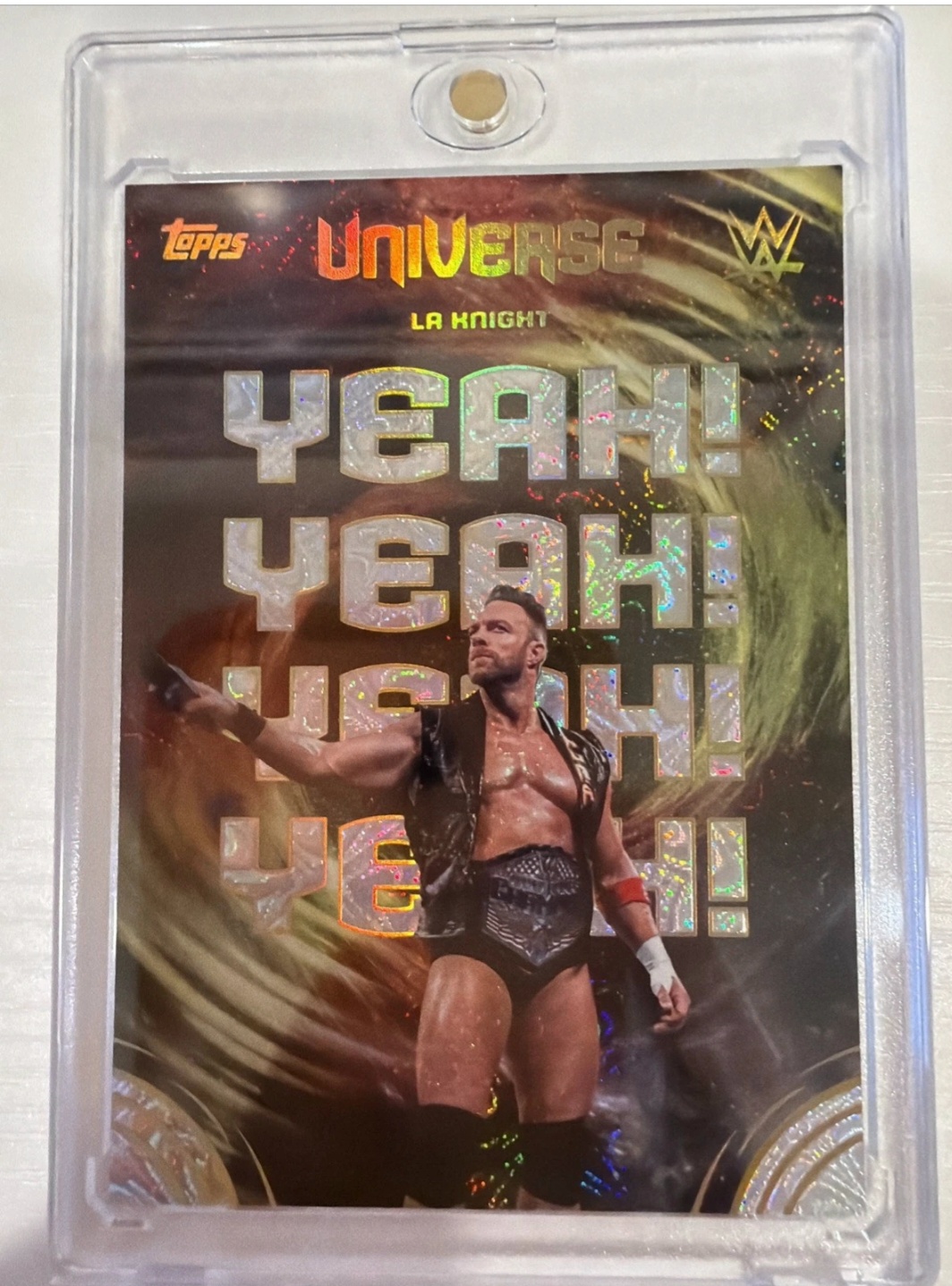
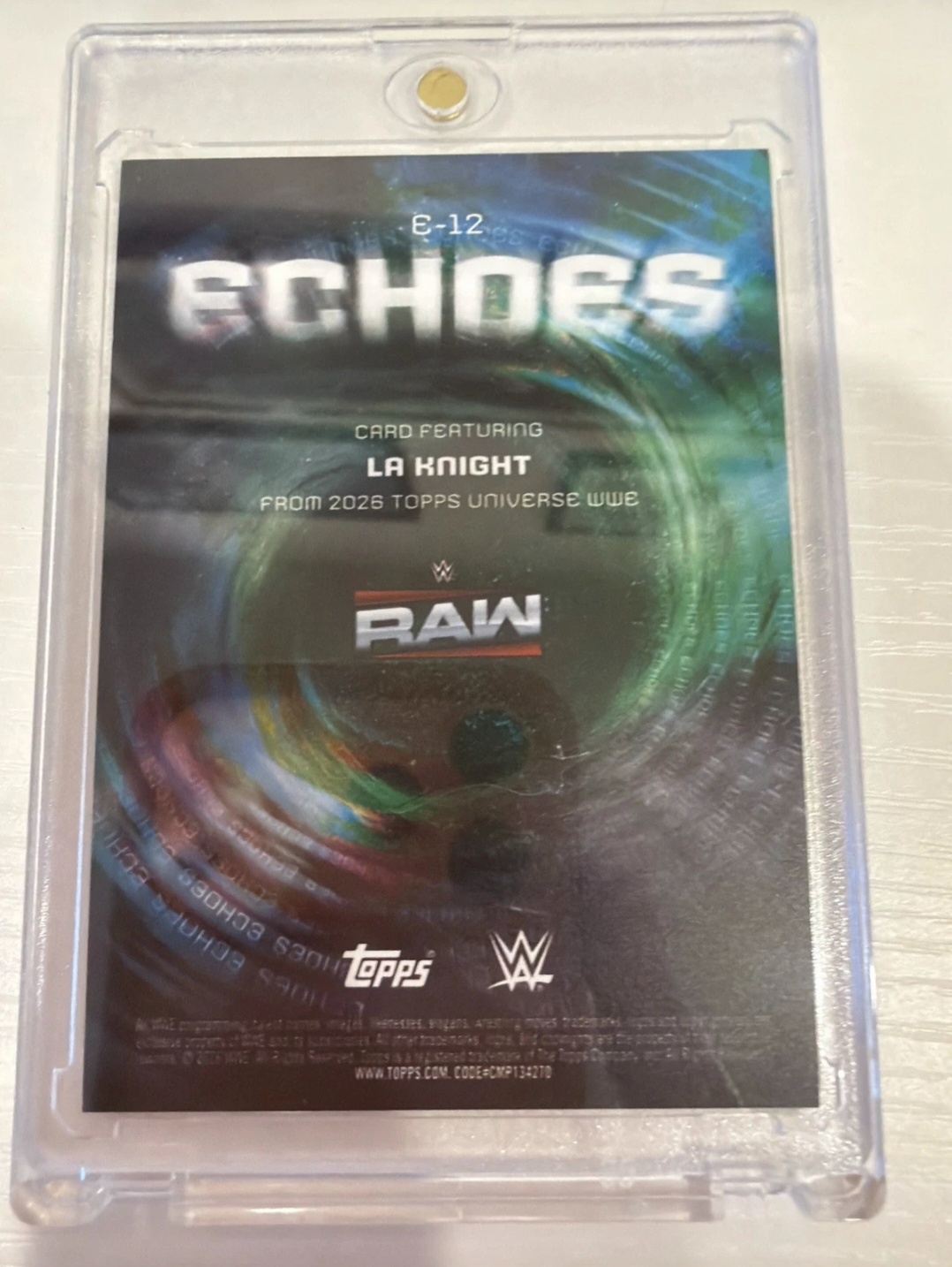
3. LA Knight
Best For: Fans who love LA Knight’s charismatic, fast-talking, brash persona.
Recommendation: 2026 Topps Universe WWE Echoes LA Knight Case Hit SSP
Brand: WWE Topps (via Ebay.com)
Pros: The big mint yeah!’s stood out to me the most behind LA Knight.
I like how they put an image of his first championship run which was the WWE United States,
I like the background of the gold twirl.
Cons: I would have put a more bright attire image shot like with the yellow trunks then black.
Price: $175.00
4. The Undertaker
Best For: Collectors who grew up watching the Deadman’s debut, early WWF/E run, and iconic rivalries such as classic rookie cards like the 1991 Classic WWF set.
Recommendation: 2026 Topps Universe WWE Undertaker Alias Case Hit SSP A-24 The Deadman
Brand: WWE Topps (via Ebay.com)
Pros: The image of shot of The Undertaker with his collar and black coat with his long hair on one side very creepy.
I like how it has the deadman behind him with mint and the moon looking spheres with the mint stars.
Cons: I like this wwe trading card of The Undertaker.
Price: $129.99
5. Roman Reigns
Best For: Best for fans who fell in love with his historic 1,300+ day Universal Championship reign, the The Bloodline storyline, and his modern “Tribal Chief” persona.
Recommendation: 2026 Topps WWE Universe Flashpoint #FP-3 Roman Reigns Case Hit SSP
Brand: WWE Topps (via Ebay.com)
Pros: The mint designs all around the card make the stand out more especially around the “Tribal Chief” Roman Reigns.
The background with the smoke and the yellow sphere make Roman Reigns loom like a God is walking on clouds
Cons: I like this wwe trading card of Roman Reigns.
Price: $189.99
6. Shawn Michaels
Best For: Ideal for fans who grew up watching the “Heartbreak Kid”, the Showstopper, and Mr. WrestleMania during the New Generation and Attitude Eras.
Recommendation: The Heartbreak Kid Shawn Michaels Alias 2026 Topps WWE Universe CASE HIT SSP
Brand: WWE Topps (via Ebay.com)
Pros: This a great shot image of Shawn Michaels with the WWF Winged Eagle Championship.
Ilike how they added the mint stars around the Heartbreak Kid wording.
The same background as The Undertaker of what suppose to be moon spheres in space.
Cons: I like this wwe trading card of Shawn Michaels
Price: $150.00
7. Rhea Ripley
Best For: Fans who love her dominant persona “The Eradicator”, “Mami”, or “The Nightmare”.
Recommendation: 2026 Topps WWE Universe Rhea Ripley Case Hit SSP Flashpoint
Brand: WWE Topps (via Ebay.com)
Pros: Rhea Ripley looks like a badass goddess with the same background of Roman Reigns with the yellow sphere and smoke at the bottom.
The detailing with the lighting strikes and the mint fireworks design in the background.
Cons: I like this wwe trading card of Rhea Ripley.
Price: $299.99
8. Mia Yim
Best For: Fans who build themed sets focusing on female Superstars, NXT alumni, or faction runs like The Baddies.
Recommendation: Mia Yim WWE Autographed 2023 Panini Select Light Blue Prizm #10 #/ 249 CGC Fanatics Witnessed Authenticated Card
Brand: Panini America (WWE Shop.com)
Pros: The image of shot of Mia yim holding the kendo stick on her back looks badass that’s what stands out to me the most the pose.
She is giving that look that you can’t mess with her and with the outfit the soldier cargo pants with the black top.
The black and blue background is her colors so that matching and her hair too.
I like how they added the raw description of her time with the O.C.
Cons: The backgroud needed to be more like a giraffe type look because her character more like a street type character.
Price: $39.99
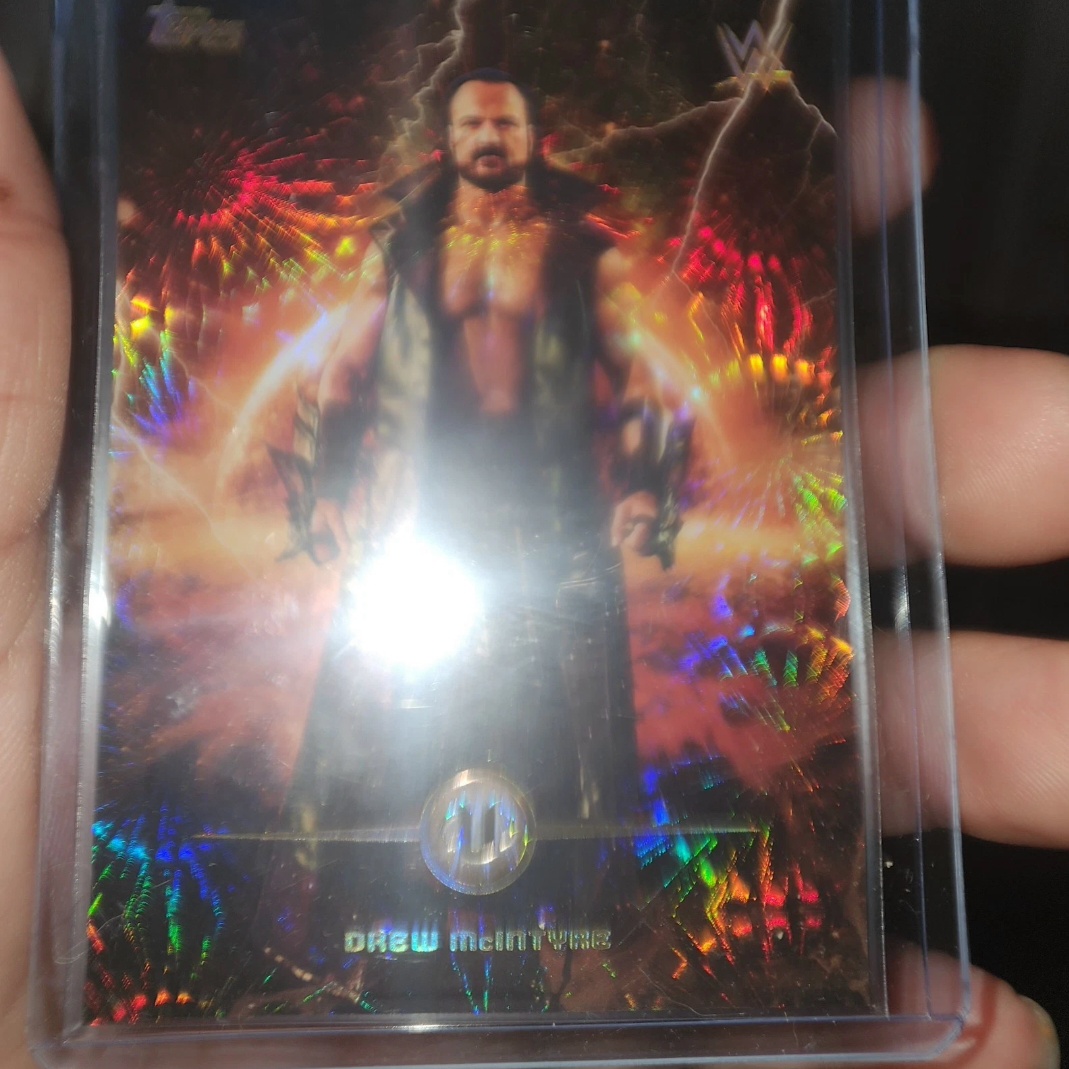
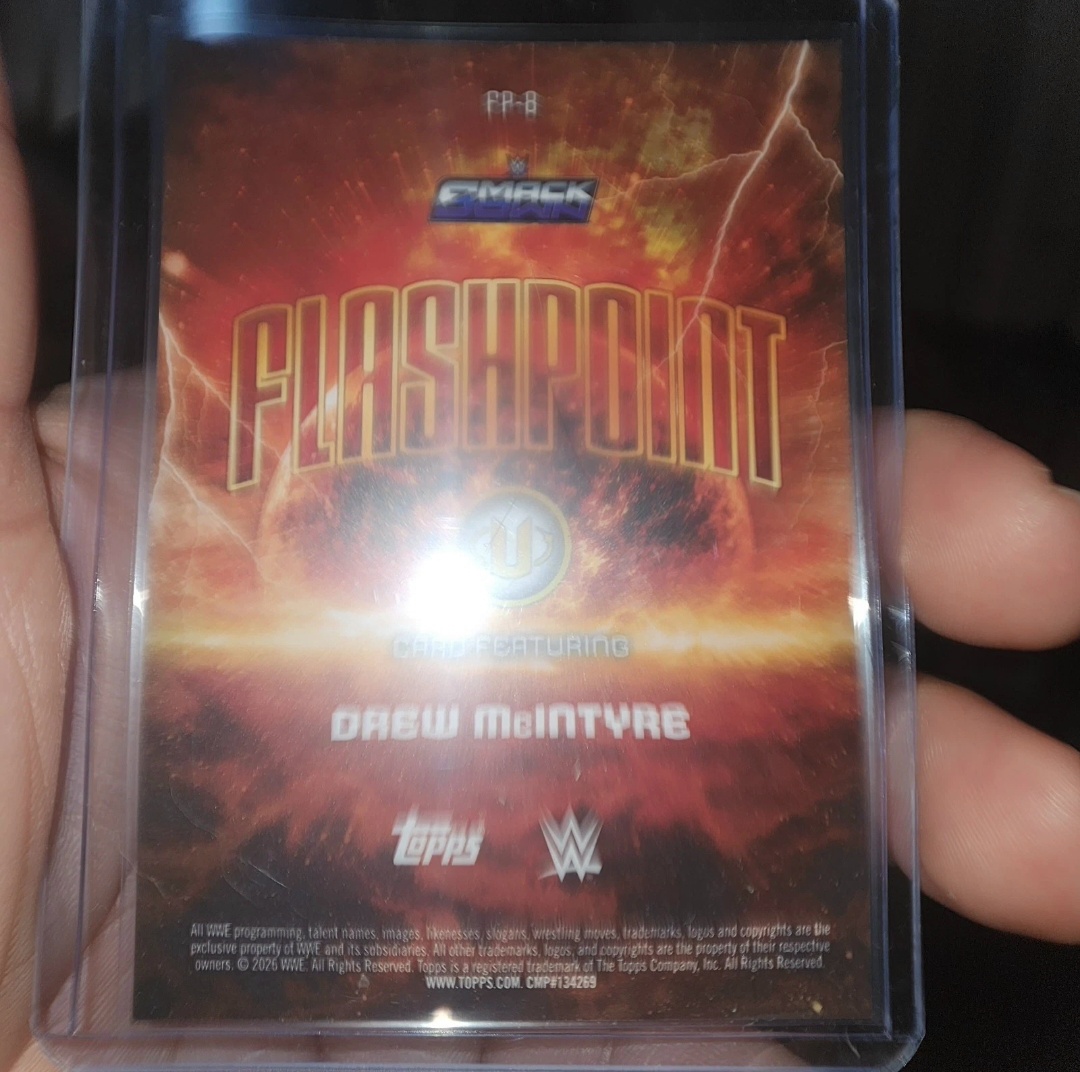
9. Drew McIntyre
Best For: Best for fans who admire McIntyre’s gritty redemption arc, world title reigns, and fierce character work in modern WWE.
Recommendation: Topps WWE Smackdown Flashpoint Drew McIntyre Insert Card #FP-8 2025
Brand: WWE Topps (bay.com)
Pros: Drew McIntyre on this image shot looks like an absolute dark badass warrior. I always like his entrance with the sick wristbands and the short leather coat.
The same background like Rhea and Roman almost like this background is made for stars like Roman, Rhea and Drew McIntyre.
He looks like he’s walking into a mega battle with the yellow sphere and the smoke with the lighting. Not to mention the mint around him.
Cons: I like this wwe trading card of Drew McIntyre.
Price: $100.00
10. Roman Reigns
Best For: Best for fans who fell in love with his historic 1,300+ day Universal Championship reign, the The Bloodline storyline, and his modern “Tribal Chief” persona.
Recommendation: Clash In Paris – 2025 WWE Topps NOW – Card CLIP – PR: 3118
Brand: WWE Topps (via Topps.com)
Pros: This image of shot of Roman Reigns in painting format is gold.
This has the same value as the Mona Lisa.
The image is fitting for the Tribal Chief Roman Reigns with the Paris background.
Cons: I like this wwe trading card of Roman Reigns.
Price: $8.99
How to Check Card Condition and Spot Counterfeits
Resurrence is key when checking a wwe trading card’scondition. At all times be on the look out for the following areas.
1. Corners: Sharp corners and machine cut riaht anales are valuable. Rounded, soft or bent corners and showina white cardboard underneath lower the value of the card
2. Edges: Analyze the straight lines of the card sides. Look for chipping silvering on foil cards, fuzzy cuts that show the card was poorly handled or stored loose in boxes.
3. Surface: Scratches, print lines, dents stains show when vou tit the card under liqht On glossy cards, fingerprints and fine scratches are easy to miss in a flat photo
4. Centering: Compare the border widths on opposite sides. A card with one thick border and one thin border is off-center. Poor centering is the easiest flaw to spot and instantly drops a card out of “Mint” condition.
There is always a professional grading companies like PSA, Beckett, or SGC. Grading cards on a 1-to-10 scale based on four critical pillars. When it comes to buying raw ungrade cards, use your phone’s camera zoom or a cheap magnifying loupe to evaluate yourself When buying online, ask for photos of the front and back with good lighting, with close-ups of the corners, if the listing does not already show them. A seller who refuses to provide this information is obviously a bad sign.
Raw vs.Graded Cards
A raw card is an ungraded from a pack or single purchase. They are usually cheaper, flexible to handle or put in binder but their condition and value are subjective. On the hand graded cards are authenticated, encased, and given a grade from 1 to 10 by a professional company like PSA.
This type of wwe trading cards cost more because the grading fee and verification are built into the price. The cards are permanently protected and most wrestling card collectors agree that for modern cards. For instance a Gem Mint PSA 10 adds major financial value over a raw copy.
For expensive cards, buying graded removes a lot of the guesswork about condition, although you should still confirm the grading company’s certificate number matches the card on the company’s own website.
Spotting Fakes And Reprints
Counterfeits tend be more common on high-value cards, such as rookie cards and autographs of popular wwe superstars.
Signs To Look For:
• The card back has different fonts, missing text, or a missing copyright line compared with a confirmed genuine example.
• A numbered card has a serial number that looks inconsistent the number is higher than the print listed for that parallel.
• An autograph card has 70 authenticatior comes from a seller who cannot say how the autograph was obtained. The price is far below recent sold listings for the same card.
• Some sellers make tribute reprint cards that are legitimately labeled as such, and these are not fakes if the listing says so, but they are not original cards either and should be priced accordingly. If a listing does not say reprint” or “custom” and the card is supposedly an old release, ask.
COUNTERFEIT CHECK AND TEST
• The Rosette/Dot Pattern Check: Under a magnifying glass, genuine sports cards are printed using a professional offset process that creates a tight, geometric honeycomb “roette” dot pattern. Counterfeits are usually printed on cheap home inkjet or digital laser printers; their colors will look muddy, pixelated, or entirely smooth with no clean dot pattern. Text lines on fakes will often look blurry or fuzzy at the edges.
• The Flashlight Test: Hold your phone’s flashlight directly up against the back of a standard card. A genuine card has a dense, dark inner layer that blocks most light. Fakes are frequently printed on cheap, thin card stock-if the light shines straight through and illuminate the front image cleanly, it is almost certainly a counterfeit
• Check Texture and foil depth: High-end modern inserts (like Panini Prizm parallels) feature precise, etched textures you can feel with your thumb. Counterfeits usually replicate this visually but feel completely flat and glossy. Furthermore, verify serial numbers like 5/99. Authentic cards have embossed or foil-stamped numbers that intent the cardboard; fakes just print flat numbers directly onto the image.
• Beware of Fake Autographs: Never trust an autograph accompanied by a home-printed “Certificate of Authenticity from an unknown third party. If buying autographed WWE cards, look strictly for “Certified Autograph” cards issued directly by official manufacturer like Topps or Panini, where the authentication statement is printed by the manufacturer directly onto the back of the card itself.
• Size Anomalies (The 1983 All-Stars Rule): If you are hunting vintage wrestling history, the famous 1983 Wrestling All Stars set (featuring early Hulk Hogan and Ric Flair is heavily faked. Authentic version of these cards are physically larger than a standard trading card. If someone tries to sell you a 1983 All Stars card that perfectly matches the size of a standard modern card, it is a known counterfeit.
How to Store and Protect WWE Trading Cards
Having the best and proper storage supplies will definitely ensure your wwe trading cards conserve their value and mint condition.
USEFUL SUPPLIES FOR WWE TRADING CARDS:
1. Penny Sleeves: Consider sliding your raw wwe trading cards into a soft, durable -quality polypropylene penny sleeve. This helps protect the card’s surface and corners from scratching then the other supplies.
2. Toploaders: Chance are you have valuable and favorite cards range from $5- $50 in value highly suggest you place your into a rigid plastic toploader. Make sure to slide in smoothly to avoid damage to the corners.
3. Side – Loading Binders: Utilizing a D-ring or a fixed-page, side-loading zipper binder to store and display will ensure a perfect visual with protection ensured, The side-loading pockets stops wwe trading cards from sliding out or gathering dust.
4. Storage Boxes: Just in case for bulk wwe trading cards or toploaded extras, use cardboard storage boxes. Some examples are 800-count or shoe style card boxes. Highly you keep them like books upright in a dry room and avoid attics and damp basements.
Beginner Buying Checklist
You can build your own collection by dividing $100 as a start and a budget. Make a simple digital checklist and or spreadsheet of the exact wrestler cards you want so you don’t overspend on impulse buys. Here is a perfect example of a great first choice maybe for you.
1. STORAGE Essentials (Spend $15):
• $7 on a heavy-duty 3-ring binder
• $5 on a pack of 9-pocket trading card sheets
• $3 on a pack of soft penny sleeves to protect your cards.
2. Targeted Card Purchases (Spend $85):
• $85 is for the main purpose which is buying specific cards of your favorite wwe superstars on Ebay, COMC and local card shop
BUILDING A WWE COLLECTION STRATEGY
Strategy: The Personal Collection Focus
Budget Allocation: $70- Singles, $30 – Supplies
Expected Items: 3 – 5 Numbered cards or low – end Autographs of your favorite wwe superstars.
Why it works: Buying single cards on sites like Ebay allows you to pick exactly who and what you want without risking money on random pulls.
Strategy: The Modern Fan
Budget Allocation: $55-Blaster Boxes, $25- Singles, $20- Supplies
Expected Items: 2 Retail Blaster Boxes (Topps Chrome or Panini Prizm) + a few cheap single cards.
Why it works: Gives you the fun thrill of “ripping packs” while leaving budget left over to buy guaranteed your favorite wwe superstars cards.
Strategy: The Vintage Route
Budget Allocation: $85- Vintage Singles, $15 – Supplies
Expected Items: Mid-grade classics from the 1980s, 90s WCW, or the WWE Attitude Era.
Why it works: Vintage cards hold long-term value, and focusing on older sets can be highly nostalgic and affordable.
FREQUENTLY ASKED QUESTIONS
Q: How should I split my $100 budget as a beginner?
Answer: The key strategy is dividing the $100 by $80 and $20. This basically you spending $80 on “Singles”; head over to Ebay or COMC. Make the choice of going for wwe superstars individually of course. You have guaranteed high-quality autographs, relics, or low-numbered parallel cards. Not to mention reducing wasting money on cards you don’t need.
On the hand you have the $20 which you can pick Retail Blaster Boxes or Packs. You have the option of buying a single “Blaster Box” or a few loose retail packs at Target or Walmart.
Q: What type of WWE cards should I look for?
Answer:
• Base Cards: The standard, most produced cards in a single set. Holding monetary value.
• Parallels/Refractors: Variations of base cards with different colored borders, patterns, or shiny finishes like green, blue, or gold refractors. These are limited edition and numbered for example (05/99).
• Insterts: Special themed card subsets like for stance 2026 “Alias” or “Lucha” sets.
• Autographs & Relics: Cards physically signed by the wwe superstars or containing a piece of event-worn gear. On-card autographs signed directly on the card are always more valuable than sticker autographs.
Q: What are the best 2026 sets to target?
Answer: Consider getting the 2026 Topps WWE Universe at $100 and Topps WWE Chrome at $35.61. The first one included 300 cards base sets includes past legends, current wwe superstars, NXT standouts, and the first ever cards featuring referees. The second has shiny, premium metallic finish and highly valuable color refractors.
Q: Are WWE cards a good financial investment?
Answer: WWE trading cards are meant for fun and enjoyment but some rare cards like 1 of 1s, short-printed inserts or iconic rookie cards.
Q: What tools do I need to track card values?
Answer: These are some the apps you can utilize for the wwe trading card value.
1. Sports Card Investor App: A free app to view pictures, track historical sales data, and find trending deals
2. Market Movers: Ideal if you want detailed, charted price actions across major online marketplaces.
3. Ebay (Filtered by “Sold |tems”): The absolutely best real-time indicator of what collectors are actually willing to pay for a card right now.
Q: Which WWE trading cards are worth money?
Answer: Usually valuable modern and modern insert cards like short-printed autographs cards like Stone Cold Steve Austin, Roman Reigns, or multi-superstar dual/triple autos numbered to 25 or fewer regularly command $400 to $1,300+.
If you already own belts, shirts and figures, you know how a WWE collection builds up: one piece at a time, usually tied to a wrestler or a moment you care about. WWE trading card collecting for beginners works the same way, with a few extra rules about card types, condition and fakes. Learn those rules before you spend, and a $100 budget goes a long way.
This guide walks through choosing a focus, understanding what you are buying, buying in the right format, protecting the cards, and keeping a record as the collection grows.
Why WWE cards are a different kind of collectible from shirts, belts and figures
A shirt gets worn, a figure gets posed, and a replica belt sits on a shelf or a stand. A card is small and flat, a standard card is about 2.5 by 3.5 inches, and its value depends on details that are easy to miss: the print run, the parallel, the condition of the corners, whether an autograph is on the card itself.
Two cards of the same wrestler from the same set can differ enormously in desirability. One is a common base card printed in large numbers. The other is a numbered parallel with a serial number stamped on it. That difference is much sharper than anything you see between two shirts of the same design.
Cards also take up almost no room. You can hold hundreds of cards in the space of one display case shelf, which makes them practical if your shelves are already full of belts and figures.
The tradeoff is that cards punish careless buying. Fakes exist, condition problems are hard to see in a bad photo, and a card you protect badly loses value from the moment it gets a bent corner. Each section below deals with one of those risks.
Pick your collecting lane before you buy a single pack
The most common way to waste money on cards is buying whatever looks good in the moment. A pack of random cards gives you random wrestlers, and most of them will not matter to you. Choosing a lane first means every purchase has a reason.
There are three lanes that work well for WWE fans.
Collect a wrestler
Pick one wrestler and buy cards of that person across every set and year. This lane suits you if your shelf already has a favorite’s shirt, figure or belt. You will find that the same wrestler appears as a base card, an insert, a parallel, and sometimes an autograph, so there is always another card to chase.
The risk is concentration. If you pick a current star, the number of cards released will keep growing. If you pick a retired legend, the supply is mostly fixed and the hunt is for older cards.
Collect an era
An era lane covers a period of wrestling you love, such as a specific decade or a rivalry period, and takes in many wrestlers. It is a good fit if you already collect vintage shirts or figures from one time frame, because the cards match what is on your shelf. It also spreads your spending across many names, so no single wrestler’s popularity decides everything.
Collect a set
A set lane means you try to own every base card in one release. You get a clear finish line: a checklist of card numbers, and you tick them off. Set building is the cheapest lane per card, because base cards are the least expensive type, and the checklist stops you from buying duplicates by mistake.
Whichever you choose, write the lane down in one sentence, for example “all cards of one wrestler from one decade” or “every base card in one set.” Before any purchase, ask whether the card fits that sentence. If it does not, skip it.
Base cards, inserts, parallels, autographs and relics: what each one actually is
Card listings use a vocabulary that confuses new buyers. These are the main types you will see.
- Base cards: The standard cards that make up the main checklist of a set. Each wrestler has one or more, and they are the most common and usually the cheapest.
- Inserts: Cards from a themed subset inside the same product, with different artwork or a different design from the base cards. They are harder to pull from packs than base cards, and the odds vary by product.
- Parallels: The same card as the base version, printed with a different finish or color. Many are numbered, meaning the card carries a serial number like 15/99, which tells you the total print run. A lower print run generally means a harder card to find.
- Autographs: Cards signed by the wrestler. Look at how the signature is applied. An on-card autograph is signed directly on the card surface, while a sticker autograph is signed on a label that is stuck onto the card. Collectors often prefer on-card, though both are legitimate.
- Relics: Cards containing a piece of memorabilia, usually a small swatch of fabric. The listing or the card back should say what the material is and whether it came from something like an event-worn or event-used item or a different source, so read that wording before you pay a premium.
Two more terms come up constantly. A rookie card is a wrestler’s first card in a major licensed release, which collectors tend to value highly. A short print is a card produced in smaller quantities than the rest of the set even though it is not numbered.
For a first purchase, base cards and lower-priced parallels of your chosen wrestler or era give you the best learning for the money. Autographs and relics cost more, and the risk of overpaying or buying a fake rises with the price.
Where to buy: hobby boxes, retail packs and singles
There are three main ways to buy cards, and each one does a different job.
Hobby boxes
A hobby box is a sealed box sold through card shops and specialist sellers. Manufacturers usually advertise a number of autograph or relic cards per box, so check the product details for that set before you buy. Boxes cost much more than a pack, and you cannot choose what comes out of them. They suit you if you enjoy opening product and your lane is broad enough that most of the cards would interest you.
Retail packs
Retail packs are the ones you find on shelves in big-box stores and some supermarkets. They cost the least per purchase and are easy to find. They tend to contain fewer high-end cards than hobby boxes, though some products have parallels exclusive to retail. They are fine for the fun of opening a pack, but they are a poor way to chase one specific wrestler.
Singles
Singles are individual cards bought from marketplaces, card shops and card shows. You choose the exact card you want and see the price before you commit. For a collector with a defined lane, singles are the best value, because you spend money only on cards that fit.
For a first $100, a sensible split is to put most of it into singles for your lane, set aside a small amount for sleeves and toploaders, and, if you like opening packs, spend a little on one or two retail packs for the experience. This is a suggestion, not a rule, but it keeps the spending tied to your focus.
To judge a fair price on a single, search for the exact card on a marketplace and filter for sold listings, not active ones. Asking prices show what sellers hope for, while sold listings show what buyers actually paid. Check several recent sales, because one unusually high or low sale can mislead you.
How to check a card’s condition and spot a fake or reprint before you pay
You can buy a card in person, where you can hold it, or online, where you rely on photos. Either way, the same four condition points apply.
- Corners: Sharp corners are valuable. Rounded, soft or bent corners lower the grade of the card.
- Edges: Look for chipping, usually visible as white flecks along dark borders.
- Surface: Scratches, print lines, dents and stains show up when you tilt the card under a light. On glossy cards, fingerprints and fine scratches are easy to miss in a flat photo.
- Centering: Compare the border widths on opposite sides. A card with one thick border and one thin border is off-center.
When buying online, ask for photos of the front and back in good light, with close-ups of the corners, if the listing does not already show them. A seller who refuses to provide them is telling you something.
Raw cards and graded cards
A raw card is one that has not been graded. A graded card has been assessed by a third-party company, such as PSA, BGS or SGC, and sealed in a tamper-evident holder with a numbered grade. Grading adds cost and confidence. For expensive cards, buying graded removes a lot of the guesswork about condition, although you should still confirm the grading company’s certificate number matches the card on the company’s own website.
Spotting fakes and reprints
Counterfeits tend to be more common on high-value cards, such as rookie cards and autographs of popular wrestlers. Some warning signs:
- The print looks blurry or pixelated compared with a known real copy of the same card. Use an image of a confirmed genuine card for comparison.
- The gloss or color looks wrong, either too dull or too shiny, or the card feels thinner or lighter than others from the same set.
- The card back has different fonts, missing text, or a missing copyright line compared with a confirmed genuine example.
- A numbered card has a serial number that looks inconsistent, or the number is higher than the print run listed for that parallel.
- An autograph card has no authentication or comes from a seller who cannot say how the autograph was obtained.
- The price is far below recent sold listings for the same card.
Reprints and custom cards are a separate issue. Some sellers make tribute or reprint cards that are legitimately labeled as such, and these are not fakes if the listing says so, but they are not original cards either and should be priced accordingly. If a listing does not say “reprint” or “custom” and the card is supposedly an old release, ask.
The same attention to detail that applies when you are checking whether a WWE shirt is truly vintage applies here: compare the details against known genuine examples and treat a price that seems too good as a reason to look harder.
Sleeves, toploaders and storage: protecting cards the way you protect your belts
A card begins losing condition the moment you handle it carelessly. Protection is cheap compared with the cost of the cards, so do it from the first day.
- Penny sleeves: Thin soft plastic sleeves that go on every card first. They guard against surface scratches and fingerprints.
- Toploaders: Rigid plastic holders. Slide a sleeved card into one for cards you care about most. Putting the card in a sleeve first avoids scratches from sliding it into the hard plastic.
- Semi-rigid holders: A softer, flexible holder that is often used for cards you plan to submit for grading.
- Magnetic one-touch holders: Rigid cases that close with a magnet. They are good for thicker cards, such as relic cards, and for display.
- Storage boxes: Cardboard boxes made for cards, which keep sleeved cards upright and tightly packed so they do not bend. Avoid stuffing them so full that cards get squeezed.
Keep cards away from direct sunlight, heat and damp. Sunlight fades color and autograph ink over time, and moisture can warp cards and cause stains. A closet shelf or a drawer in a room with steady temperature is a better place than a windowsill or garage.
Handle cards by the edges, and make sure your hands are clean and dry. Do not stack loose cards without sleeves, and do not use rubber bands, which dent edges and leave marks.
Treat your cards the way you treat your belts. If you take care to keep a replica championship belt out of the sun and free from scuffs, apply the same standard to a small piece of cardboard that may be worth more than you expect.
How to track what you own and grow the collection over time
Once you have more than a handful of cards, you will forget what you own. A simple spreadsheet fixes this. Create one row per card with these columns:
- Wrestler name
- Set name and year
- Card number
- Card type (base, insert, parallel, autograph, relic)
- Parallel name and serial number, if it has one
- Condition notes, or the grade if it is graded
- Price paid and date bought
- Where you bought it
- Current estimated value, based on recent sold listings
Take a clear photo of each valuable card and store it in a folder with the spreadsheet. If you ever need to prove what you own, for a sale or an insurance claim, the record is there.
Update estimated values every few months rather than every week. Prices move with wrestler popularity, news and demand, and checking daily will only make you anxious.
Growing the collection
Growth should follow your lane. A few ways to do it:
- Fill gaps: Use your spreadsheet to see which cards in your lane you are missing and look for those.
- Upgrade condition: Replace a worn copy of a card with a cleaner one, and sell or trade the first.
- Sell duplicates: Cards outside your lane or doubles you picked up can fund your next purchase.
- Trade: Card shows, local shops and online communities often have collectors willing to swap cards that fit your lane.
- Add a higher tier slowly: When your base cards and parallels feel complete, consider one autograph or a numbered parallel. Buy it only after you have studied sold listings and confirmed authenticity.
Set a monthly budget and stick to it. A collection built with steady, planned purchases is easier to enjoy than one built from impulse buys followed by regret.
Where cards fit in your wider WWE collection, and what to read next
Cards work best when they connect to what you already own. If you have a replica belt from a particular champion’s reign, a card of that champion adds context to the shelf. If you collect figures of a specific era, cards from the same period fill out the display. A collection with a shared theme tells a clearer story than a pile of unrelated items.
Think of your whole WWE collection as a set of categories: apparel, belts, figures, and now cards. Each has its own buying rules, but the habits are the same. Choose a focus, check authenticity, protect what you buy, and keep records. If you want to explore the other categories, the site’s pages on WWE replica championship belts and limited edition WWE Funko Pops cover them.
Pick one wrestler or era to collect and buy your first five singles this week. Then see how to display your wider collection in our guide to showing off WWE championship belts.